- What Are the Best Growing Conditions?
- What Are the Planting Considerations Specific to Rhododendrons?
- Can I Move My Rhododendron?
- Can I Grow My Small Rhododendron in a Pot?
- Do I Need to Fertilize My Rhodos?
- Do I Need to Prune My Rhododendron?
- My Rhodo Sometimes Blooms in the Fall or Winter. Is There Something Wrong with It?
- Resources
What Are the Best Growing Conditions?
- Rhodos need some shade and some sun.
- Plants with smaller leaves can take more sun (but not more heat) than those with larger leaves.
- Because their roots are shallow, rhodos need good soil drainage and routine watering.
- Rhodos need porous soil to allow air to penetrate to the root zone.
- Protect from consistent wind.
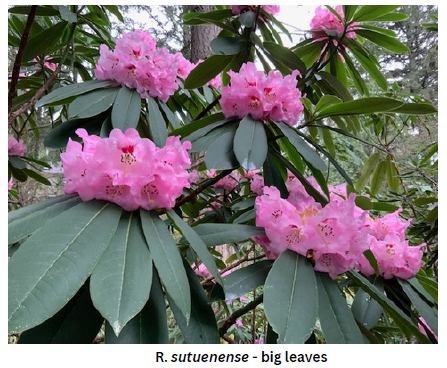
Fun Fact … Bees use the lines, spots, or blotches in rhododendron flowers, known as nectar guides, to direct them toward the nectar and pollen. These markings function like “runway lights” that guide pollinators to the reproductive parts of the flower.
What Are the Planting Considerations Specific to Rhododendrons?
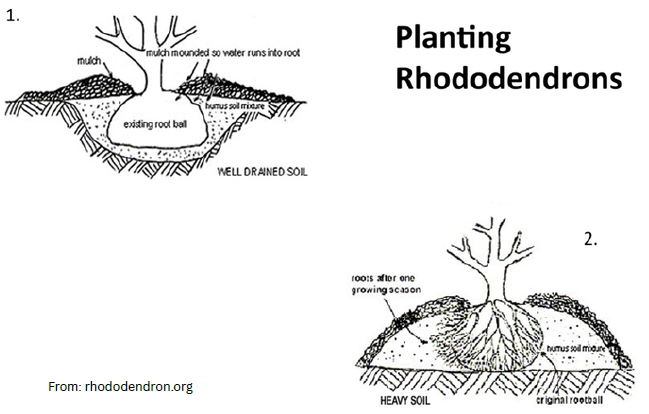
- In heavy or clay soil, plant in a mound on top of the existing soil.
- In light soil, dig a hole 3 times as wide as and about an inch deeper than the root ball. Backfill with a mixture of half native soil, a quarter fish compost, and 1/4 medium or coarse bark much.
- In dry soil, water the hole well before planting.
- Apply 2-3 inches of medium or bigger mulch. Arborist wood chips are highly recommended.
Can I Move My Rhododendron?
- Rhodos have shallow roots, making them easy to move.
- Dig around the root ball out at the drip line, pry plant up and slide onto a tarp to move to a new location.
- Best time to move a rhodo is the fall but they can be moved any time in our climate, as long as enough of the root ball is included, they are planted according to the above instructions, and are kept watered through the dry season.
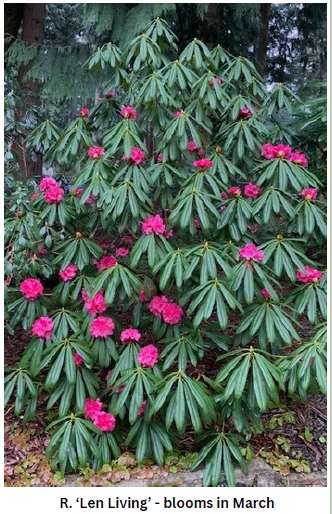
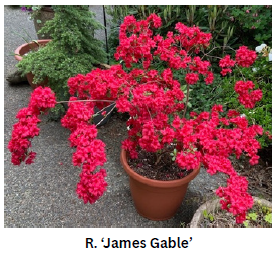
Can I Grow My Small Rhododendron in a Pot?
- Rhodos that will grow slowly and have smaller leaves are better suited to growing in pots.
- Rhodos in pots will dry out more quickly and are less protected from the elements in winter.
- The upside is pots can be moved out of the afternoon sun and closer to where they will be watered.
Do I Need to Fertilize My Rhodos?
- Healthy, established plants that are growing well do not need fertilizer.
- Recently purchased plants do not need fertilizing since they have usually been heavily fertilized in nurseries.
- If you think your plant has a nutrient deficiency, consult a professional or send a description and close-up pictures to GardeningAdvice.MilnerGardens@shaw.ca to get advice from a team of Vancouver Island Master Gardeners. You could also get your soil tested.
Do I Need to Prune My Rhododendron?
- Pruning should not be necessary if the plant is properly located and has enough space.
- Prune out dead wood any time you notice it.
- Tip prune larger plants when there is only one new leaf truss after blooming.
- Taking off spent flower trusses is not necessary but will make the plant look tidier and can promote flower production for the next year.
Questions about growing or choosing rhododendrons? Email: GardeningAdvice.MilnerGardens@shaw.ca. Vancouver Island Master Gardeners will reply to your queries. Sending photos would be helpful if your plant has issues.
My Rhodo Sometimes Blooms in the Fall or Winter. Is There Something Wrong with It?
Rhododendrons set their flower buds prior to winter. With our increasingly warm falls and winters, sometimes plants get confused and start opening their flower buds early. Those flowers that do open will likely be frozen in the cold spells. Unfortunately, they will not re-bloom in the spring when they should. This problem is seen more frequently with climate change.
Resources
- Greer, H.E. 1996. 3rd Ed. Greer’s Guide to Available Rhododendrons. Offshoot Publishing. Available through Rhododendron Society Chapters on Vancouver Island or in the Gardening section in used bookstores.
- Rhododendron Species Botanical Garden. https://rhodygarden.org/
- American Rhododendron Society. https://www.rhododendron.org/
- Photo credits: Chris Southwick, from her garden of over 300 rhododendrons.
Vancouver Island Master Gardeners
Vancouver Island Master Gardeners are made up of local volunteers who educate the gardening public with current, science-based, and environmentally responsible horticultural information. As a chapter of the Master Gardeners Association of BC (MGABC), our program and priorities shape healthy communities and a healthy planet.