
1. Before you Prune
Determine your pruning objective. Are you pruning for:
- Plant health
- Aesthetics
- To control size
- Fruit production and accessibility
- Shaping young plants for health and function
- Safety of people and structure
Research your plant to determine the best time to prune. Refer to RHS Pruning Groups: https://www.rhs.org.uk/pruning/rhs-pruning-groups
2. Steps for Pruning
- Begin pruning by focusing on the 4 Ds:
- Dead or dying – can be removed any time of the year.
- Diseased – cut back at least 10 cm (4″) into healthy wood, if possible.
- Damaged – eliminate pathways for disease by removing broken branches and those with wounds.
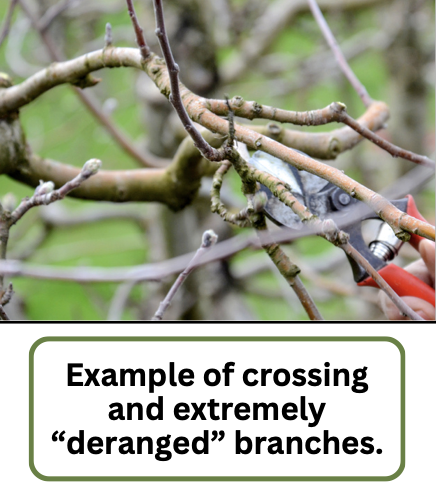
- Deranged – branches growing in the wrong direction, out of proportion to the rest of the plant or crossing and rubbing on other branches.
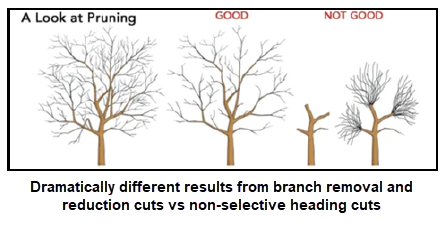
- 2. Open up the whole plant to light and air using mostly branch removal cuts.
- 3. Prune for shape using mostly, if not all, branch removal and reduction cuts.
For the different types of pruning cuts, see our InfoSheet “What Are the Basic Pruning Cuts?”: https://www.vimga.org/wp-content/uploads/2026/02/FINAL-What-are-the-basic-pruning-cuts.pdf
3. How Much to Remove
Most plants have a ‘pruning budget’ of no more than 15% of the plant in one growing season.
Removing too much can result in an explosion of growth or death of the plant.
4. Multi-Stemmed Shrubs and Cane Growers
Plants that send up new stems from the root ball under the ground every year, such as hydrangeas, lilac, hazel, blueberry, raspberry, forsythia, etc.
Shearing will result in many small stems and tiny leaves just on the outside of the plant, which changes its natural form and growth habit, and is therefore not recommended.
Instead …
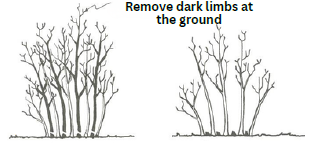
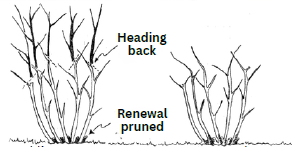
- For established plants, remove the oldest 1-3 stems right to the ground every year. Any stubs left behind will either die (unsightly and a path for disease) or will sprout weak shoots (also unsightly).
- Simplify remaining stems by tip pruning or heading back.
- Head back the whole plant to rein it in if it gets too big and floppy.
- Renovate an overgrown plant by removing 1/3 of oldest stems 3 years in a row.
- Renew by cutting the entire plant to the ground.
Physocarpus obtusifolia ‘Coppertina’ – Ninebark
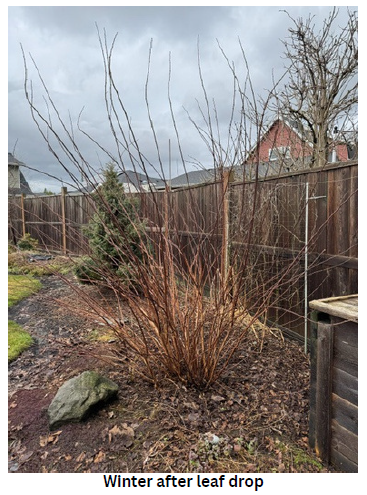
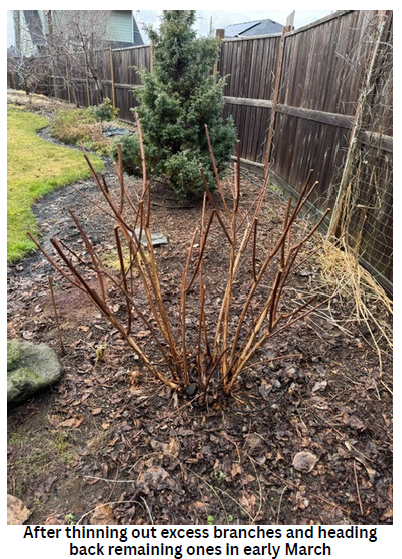
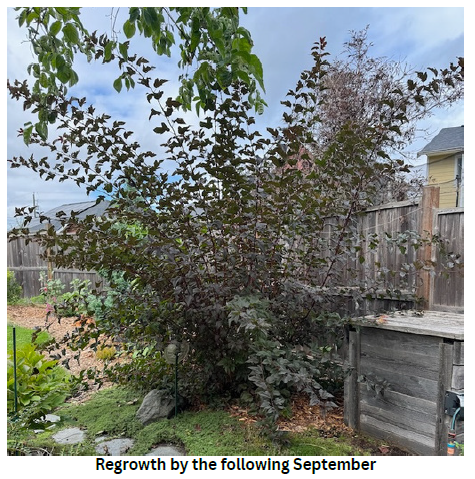
“Prune to natural form so your work becomes invisible.”
Resources
- Finch, C. 2014. To prune or not to prune. Garden Style, San Antonio. https://www.gardenstylesanantonio.com/garden-articles/to-prune-or-not-to-prune/
- Wiederholt, K. 2024. Pruning Shrubs for Fruit and Beauty. NDSU Carrington Research Extension Center. https://www.ag.ndsu.edu/carringtonrec/archive/documents/northernhardyfruitevaluationprojectrd/docsnoyear/pruning-shrubs-for-fruit-and-beauty
- Turnbull, C. 2012. Cass Turnbull’s Guide to Pruning. 3rd Ed. Seattle, WA: Sasquatch Books.
- Gurrad, D. 2023. Introduction to Pruning. Vancouver Island Regional Library (VIRL) Virtual Garden Series. https://www.youtube.com/watch?v=cSphd2xFpSM&list=PLSJ2NS0iLhMvjrnaov6XSU1FB-_TeYhT2&index=28
Vancouver Island Master Gardeners
Vancouver Island Master Gardeners are made up of local volunteers who educate the gardening public with current, science-based, and environmentally responsible horticultural information. As a chapter of the Master Gardeners Association of BC (MGABC), our program and priorities shape healthy communities and a healthy planet.