
Four Seasons of Bulbs for Woodlands and Shade
by Jo-Ann Canning
The class of plants called geophytes have five different subterranean storage organs that evolved to help them survive unpredictable weather patterns at the edges of the world’s many growing zones. We call them bulbs. They are all perennials. The key to growing bulbs is to give them the optimal dormant conditions where their unique storage organs have a chance to replenish themselves. Notes on right-plant-right-place in the lists refer more to this aspect than of their blooming seasons.
The summer list is much shorter than springtime offerings. Many summer bulbs are spring-planted, and are not suited to the easy-care shade or woodland setting because they are either too tender, or are sun- and drought-lovers (either summer or winter). The following are the exceptions, suited to the woodland setting:
- Ornamental or Flowering Onion Species (Allium)
- Jack-in-the-Pulpit or Cobra Lily Species (Arisaema)
- Mouse Flower (Arisarum proboscideum)
- Elephant Ear Species (Caladium)
- Wild Canna Lily (Canna indica)
- Himalayan Lily (Cardiocrinum giganteum)
- Purple Cyclamen (Cyclamen purpurascens)
- Hosta Species (Hosta)
- Lily Species (Lilium)
- Calla Lily Species (Zantedeschia)
Ornamental or Flowering Onion Species (Allium)
The genus are usually sun lover that bridge the spring-summer seasons. See species information under the spring list for those which tolerate some shade.
Jack-in-the-Pulpit or Cobra Lily Species (Arisaema)
These unusual true-shade lovers are related to the calla lily (Zantedeschia). All are different heights yet have similar form: a spike-like flower(spadix) surrounded by a colourful bract (modified leaf) called a spathe that often droops over top, like a hood. They are striking specimens on patio, shaded deck or at a pathway junction.
| A. speciosum | The cobra lily. 30cm / 8-inch purple and white spathe on a 1m / 3 foot stem is matched by purple mottled leaves. |
| A. sikokianum | The Japanese species. It is the smallest in this group. |
| A. triphyllum | Also called Jack-in-the-pulpit, it is native to Eastern woodlands of North America. |
| A. thunbergii | Commonly called cobra lily, it is closely related to the jack-in-the-pulpit. It sports a spectacular deep purple and black striped spathe. |
Mouse Flower (Arisarum proboscideum)
The mouse flower is a true shade lover and needs constantly moist ground. Its grey-mauve and white mid-season blossoms are quirky, small and, yes, shaped like a little mouse with a long, curled tail.
Elephant Ear Species (Caladium)
This is a tropical genus adapted to cooler climates and is hardy in Zone 9a (with protection) and above. Even in zone 9, it is recommended to lift bulbs and store or grow as an annual. Caladium is grown for its many coloured, heart-shaped leaves which brighten a shady patio or garden bed. The plants grow 30-60cm / 12-30 in 30-90cm / 12- 24 inches wide.
Warning: Be advised, these beautiful leaves contain calcium oxalate so keep them away from children and pets.
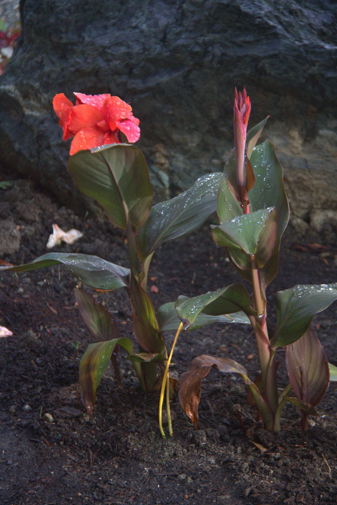
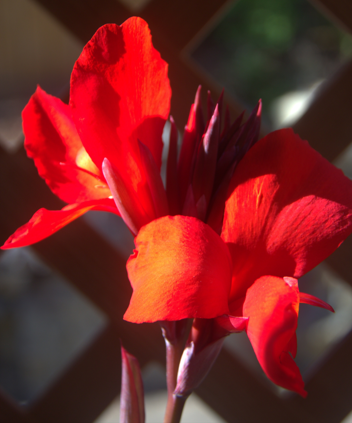
Wild Canna Lily (Canna indica)
The wild canna is a sub tropical bulb but has been bred for cooler regions and will thrive with a little protection in Zone 7. The canna prefers full sun, but it still thrives in part shade though it will offer fewer and smaller blooms. It is prized for its richly coloured leaves as much as for blooms that range from yellow through deep crimson.
Himalayan Lily (Cardiocrinum giganteum)
The Himalayan lily needs filtered sun or light shade to be happy and does well in our climate as long as it gets summer moisture and no hard freeze. In July and August it produces huge white flowers with red markings. It can be slow to establish but once settled in becomes a spectacular 9 foot- giant.
Purple Cyclamen (Cyclamen purpurascens)
The second exception among a genus known for autumn flowers. This partially evergreen species has fragrant blooms and red-backed leaves lined in silver.
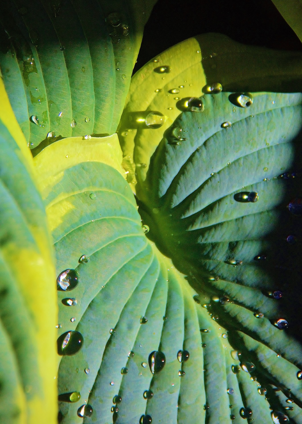
Hosta Species (Hosta)
Classified in many catalogues as a herbaceous perennial the botanists at the American Hosta Society state it is actually a geophyte who offers a large array of sizes and leaf colour. Grown mainly for its leaves, the white and gold colours offer a wonderful pop of colour in the shady border. And for those who like to forage, the tightly curled new leaves are edible. Hosta tolerates part sun through shade — except total shade. Blue-leaved varieties are the most shade tolerant. Some varieties, like ‘Royal Standard’ have fragrant blossoms. Hostas die back to subterranean crowns in autumn.
Lily Species (Lilium)
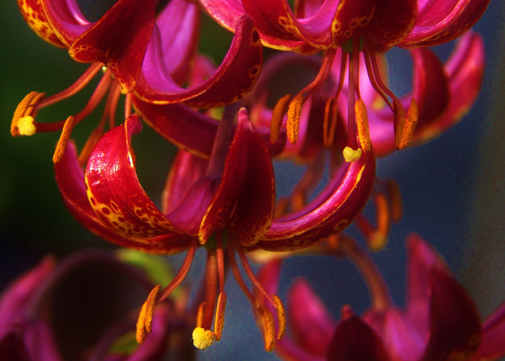
Modern hybrid lilies do not do well in a woodland setting. The native North American and Martagon species however, are quite happy in dappled or partial shade. They add a unique dimension to our shade gardens and reward our efforts with spots of colour floating above the woodland floor. Plant on mounds of leafy, gritty, well-drained soil that stays evenly moist, and with a minimum of 2 hours of sun a day. Although most of the species lilies are difficult to find and difficult to establish, following are some that are recommended for the easy-care woodland garden:
| L. columbianum | The native pacific coast woodland lily. It is nodding like the martagon, bright orange like the tiger lily, and blooms early in the season. |
| L. henryii | The tiger lily is native to China and thrives in dappled shade though it will tolerate full sun. |
| L. superbum | The Turks-cap lily is by far the easiest to grow. Its blooms are orange to magenta with purple or brown speckles. The recurved, nodding flowers appear July through August. |
| L. martagon | Another similarly coloured Turks-cap from Mongolia, but this one also offers a white variety (v. album). |
Calla Lily Species (Zantedeschia)
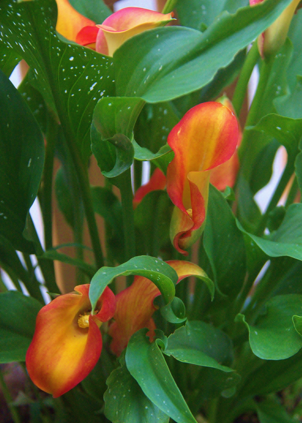
Most calla lilies are suited only to indoor gardens, but two calla lilies do well in zone 7b and above. The more colourful blooms are less hardy and need more sun, so check their needs before purchasing and consider bringing the bulbs inside for winter.
| Z. aethiopica | This is the earlier bloomer, evergreen in a protected spot, blooming in late spring through summer. It does best in moisture-retentive soil so is suited to a pond or stream margin in light shade to part sun. |
| Z. elliottiana | The golden calla has blooms that begin as green-rimmed white then mature to deep yellow. |
Terms Used for Sun and Shade
- Full sun: At least 6 hours beginning at 10AM, continuing through until approximately 4PM.
- Part sun
- a): Morning between dawn and 2:00PM, then dappled or full shade in afternoon or evening. Most plants in this group do best in afternoon with dappled light.
- b): Dappled or full shade until noon, then full sun in afternoon through evening. This is often treated as full sun when there is more than four afternoon hours of sun, even if evening is shady, because this is when sun is brightest and hottest.
- c): This is seasonal sun, and for bulbs, refers to those earlier bloomers that thrive under deciduous trees then need their dappled shade canopy during their dormant season. These are best planted in the circle of mulch within the drip line so their greenery is not mowed down when the grass begins to grow.
- Shade
- a): Dappled sun/shade all day. It will vary in brightness but does not offer unprotected ground.
- b): Very few bulbs survive in true, full shade. Most that do are bog plants.
Sources
- A-Z Encyclopedia of Garden Plants, Canadian Edition, Eds., Brikell, Roles, and Cole, Dorling Kindersley, Ltd, Toronto ON, Canada, 2004.
- Bulbs for All Seasons, Edinger, Lang, Sunset Publishing, Menlo Park CA, 1999.
- Bulbs, the Four Seasons: a Guide to Selecting & Growing Bulbs All Year Round, Brian Matthew, Pavilion Books, London UK 1998
- Gardening With Native Wildflowers, Jones, Jr., Foote, Timber Press, Portland, Oregon, 1999
- Lois Hole’s Favorite Bulbs, Hole’s Publishing, St. Albert, Alberta, Canada, 2003.
- The New Flower Expert, Millennium Edition, Hessayon, Transworld Publishers, London, UK, 1999.
- The Woodland Garden: Planting in Harmony with Nature, Forster & Downie, Rain Coast Books, Vancouver, BC, 1999.
- BBC Gardeners World Magazine, September, 2018
- www.phoenixperennials.com
- www.gardenia.net
- www.paficibulbsociety.org
- www.RHS.org.uk (Royal Horticultural Society of the UK)
- www.gardenia.net/guides/
- linnet.geog.ubc.ca/biodiversity/eflora/ (E-flora BC atlas)
© J. Canning, 2010, 2021, 2026