
Four Seasons of Bulbs for Woodlands and Shade
by Jo-Ann Canning
The class of plants called geophytes have five different subterranean storage organs that evolved to help them survive unpredictable weather patterns at the edges of the world’s many growing zones. We call them bulbs. They are all perennials. The key to growing bulbs is to give them the optimal dormant conditions where their unique storage organs have a chance to replenish themselves. Notes on right-plant-right-place in the lists refer more to this aspect than of their blooming seasons.
For gardeners in the Pacific Northwest, spring flowers begin in February, in late winter, even in a mild January when Galanthus and species Crocus brave the soggy soil. Hardy blossoms brighten the dark days and coax out the early wild pollinators. For gardeners inland and at altitude, know your last frost date, soil temperature and moisture content in late winter through the frost date as these are key to early blooms. Sometimes ‘three feet to the right” makes two to three weeks difference in both emergence and flowering.
The following spring bulbs are the most common offerings in garden centres:
- Ornamental or Flowering Onion Species (Allium)
- Windflower Species (Anemone)
- Crocus Species (Crocus)
- Lily-of-the-Valley (Convallaria majalis)
- Fumewort (Corydalis solida)
- Spring Sowbread (Cyclamen repandum)
- Trout Lily or Dog-Tooth Violet Species (Erythronium)
- Fritillaria Species (Fritillaria)
- Bluebells Species (Hyacinthoides)
- Springstar (Ipheion uniflorum)
- Dwarf Crested Iris (Iris cristata)
- Snowflake Species (Leucojum)
- Grape Hyacinth Species (Muscari)
- Daffodil Species (Narcissus)
- Striped Squill (Puschkinia scilloides)
- Squill Species (Scilla)
- Tulip Species (Tulipa)
Ornamental or Flowering Onion Species (Allium)
This genus bridges the spring-summer seasons, blooming in May and June. Most are sun lovers. The following are partially shade tolerant, and demand well-drained soil year round. Alliums are magnates for pollinators.
| Allium ‘Mt. Everest’ | The shortest of the genus at only 15cm / 6 in, it features very broad grey leaves and large white globes. In mild areas it can bloom as early as mid-April. |
| A. uniflorum | The west coast North American wild onion. Its medium height stalks (30-60 cm /12 to 24 in) are topped with loose, drooping clusters of rose-pink, star-shaped blossoms. |
| A. moly | Similar in shape to its wild cousin, A. moly’s yellow blossoms sit on slightly shorter stalks. |
| A. hollandicum ‘Purple Sensation’ | The Persian onion, (often called Dutch garlic) sports medium sized globes atop 90 cm / 36inch stalks. |
Windflower Species (Anemone)
These early bloomers are not only cold tolerant they need a good annual chill for long-term performance. Perfect under trees in the woodland, they quickly form a carpet of colour before the trees green up, then die down, so are untroubled by the shade. Some, like A. blanda also do well in some meadow settings.
| A. blanda | Vivid blue blossoms early- to mid-season compliment the whites and yellows of late crocus and short species tulips. Does well naturalized in short meadow grass. |
| A. apennina | Appears several weeks after A.blanda and is usually sky blue though white and pink are also available. |
| A. nemorosa | The small, white, woodland anemone that needs cool conditions and constant moisture. In acidic soil rich in humus, these little gems spread rapidly. They cannot tolerate dry soil, so do not plant under pine or spruce trees. |
Crocus Species (Crocus)
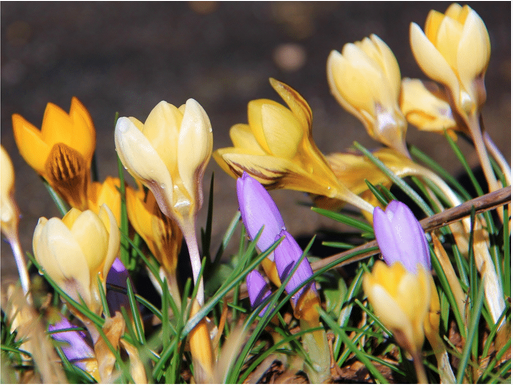
Crocus biflorus and Crocus chrysanthus have been hybridized for larger blooms in many colours, often labeled as Crocus chrysanthus cultivars. These give us the second flush of colours in early spring and are the foundation of many named varieties. The hybrids need more sun than the species to remain healthy and develop into clumps, so are best suited to the partial sun of the very front of the border, or under deciduous trees and shrubs.
Lily-of-the-Valley (Convallaria majalis)
Lily-of-the-valley is a late spring bloomer. It is highly scented, long-lived. It MUST have shade, and damp, rich mulch all year. Try it under a Spotted Laurel (Aucuba japonica) in deep shade. Though often an expensive tuber, it is very long-lived and spreads quickly.
Fumewort (Corydalis solida)
This is a spreading ground cover with fern-like foliage that offers rows of purple blossoms along the flower stem. Some varieties are red. Good in light shade foreground as tall cover, or spreading over walls and through rockery. A wonderful companion to ferns.
Spring Sowbread (Cyclamen repandum)
This crimson flowered spring bloomer is one of the exceptions among a genus known for autumn and winter leaves and flowers. See a more complete genus description under the winter and autumn listings.
Trout Lily or Dog-Tooth Violet Species (Erythronium)
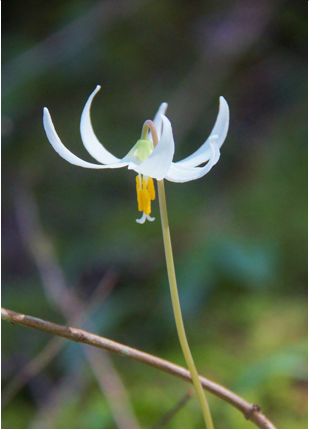
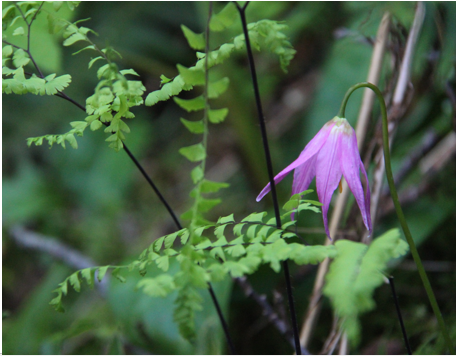
This group sports small blooms on 15cm / 6 in to 25cm 10 inch stalks whose recurved, nodding habit shows their membership in the lily family. Happy in shade on the moist woodland floor, they are some of the easiest to grow of the woodland flowers. The Pacific Coast is home to several natives that are offered in local garden centres.
| E. tuolumnense | Cultivars ‘Kondo’ and ‘Pagoda’ both bloom in shades of yellow, are vigorous and easy to obtain. |
| E. oregonum | A larger species with creamy white flowers. |
| E. americanum | The yellow trout lily. It does well in colder areas, hardy to Zone 4. |
| E. dens-canis | The European dog-tooth violet. It bears pink, white or lilac flowers that are only 1 ½ inches across. |
| E. albidum | The blossoms of the North American dog-tooth violet are almost a foot tall and is also hardy to Zone 4 |
Fritillaria Species (Fritillaria)
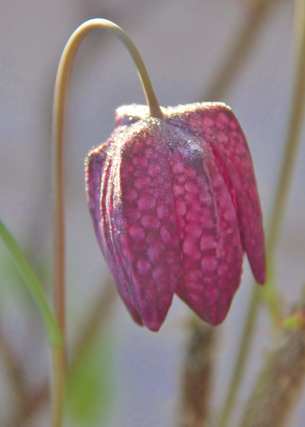
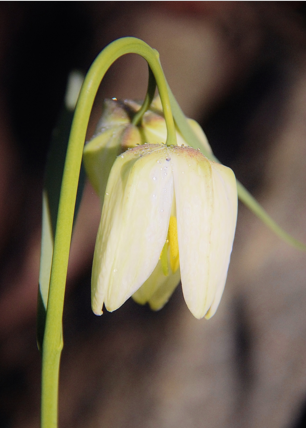
A varied genus whose members have quite different needs. The woodland group does best in moisture retentive, humus rich soil, and needs cool summer temperatures. Fritillarias are known for strangely patterned flowers.
| F. camschatcensis | The chocolate lily bears dark purple-black pendant flowers grouped on 5 inch stems. |
| F. meleagris | The foot-tall checkered lily does indeed have checkered deep pink blooms. |
| F. meleagris ‘Alba’ | It is the same height as F. meleagris but has blooms in a white and off-white checkered pattern. |
| F. affinis | Taller than F. meleagris (up to 2 feet) with flowers that are greenish white with purple speckles. |
| F. uva-vulpis | Short (8 inches) and understated, it’s perfect near a walkway where its yellow-bordered, dark brownish purple, pendant bells can be enjoyed close up. |
Bluebells Species (Hyacinthoides)
Bluebells were formerly found under the genus Scilla, then Endymion. The Spanish bluebell is taller (about 50cm / 20 inches) with erect stalks whereas the English bluebell is 30.5cm / 12 inches, arching, and fragrant. Both species are available in blue, white, and pink. They cross-breed readily when planted near to each other, so many gardens sport hybrids.
| H. hispanica | The Spanish bluebell. |
| H. non-scripta | The English bluebell, mainstays of the shady, damp garden. |
Springstar (Ipheion uniflorum)
These charming little six-petaled flowers need regular water during their bloom time but prefer dry summer dormancy, accepting water only where the drainage is very good. This makes them great choices for naturalizing on a rocky hummock that dries out in summer, or in the grass on a partly shaded slope.
Dwarf Crested Iris (Iris cristata)
The miniature crested iris grows only 13-15 cm / 3-5 inches. Light blue, hardy from zones 3-9, native to the east and Midwest USA. It thrives in the dappled shade of a meadow environment.
Snowflake Species (Leucojum)
Similar in appearance to the Snowdrop (Galanthus) these bloom later in the season and continue well into summer. Most in this genus want sun, but the following species need bright light but very little direct sunshine. Grow them in humus rich soil that stays damp. They thrive near water.
| L. vernum | Whose common name is the spring snowflake, gives us green-tipped nodding bells on 12 inch stems. |
| L. aestivum | The 16 inch chocolate-scented white flowers of the summer snowflake actually begin blooming in spring. |
Grape Hyacinth Species (Muscari)
The 15cm / 6 in to 20cm /8 inch stalks of grape-coloured spheres are the trademark of the vigorous, easy-care grape hyacinth. The strap-like leaves often appear in autumn to stand over winter marking where the blooms will appear in mid-spring. They spread readily. There are many cultivars to choose from, each offering a range of florescence in blues through purples.
| M. botryoides | The common grape hyacinth is spectacular planted along shallow forest swales where it gives the effect of an undulating stream. It self-sows readily. |
| M. botryoides v. album | Has slender stalks of fragrant, white flowers. |
| M. armeniacum | Will self-sow from seed, can become invasive. |
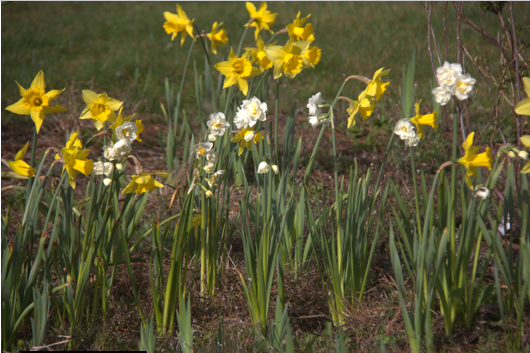
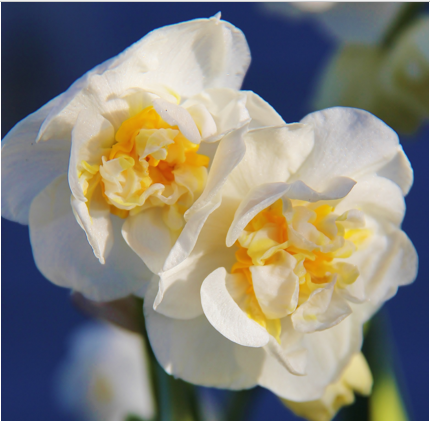
Daffodil Species (Narcissus)
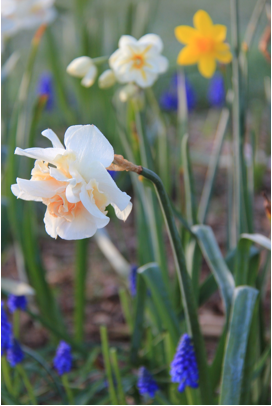
Narcissus is considered one of the most versatile and durable garden flowers and is often called the daffodil. A varied genus, it has 12 separate divisions. Most of this genus needs more sun during dormancy than common knowledge has it, or the bulbs become diseased and die off quickly. Planting in part sun – either morning or afternoon – is a good strategy but make sure that during bloom-time there is at least 4 hours of mid-day sun. All divisions can be planted under deciduous trees as long as the drainage is good and summer moisture minimal. Choose a tree with a taproot, as shallow fibrous roots will interfere with the bulbs. Narcissus blooms are often bi-coloured, with the perianth (the ‘back collar’ petals) and the corona (the trumpet) in varying shades of white through bright orange and pink.
Striped Squill (Puschkinia scilloides)
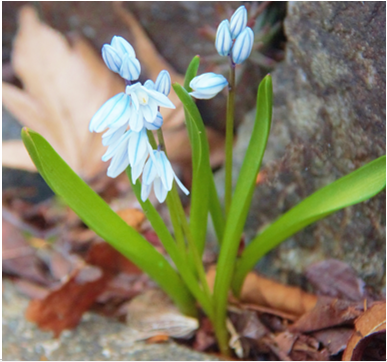
These blue-striped white flowers that look much like bluebells appear about the same time as their relatives, Glory-in-the-Snow (Chionodoxa) and Squill (Scilla). The three are a lovely companion group of flowers. Puschkinia does best in partial shade, are the hardiest of the bluebell-shape flowers (to Zone 3). Plant them early in the autumn so they have ample time to root before winter. They like moisture retentive soil all year, so make sure they do not dry out in summer.
Squill Species (Scilla)
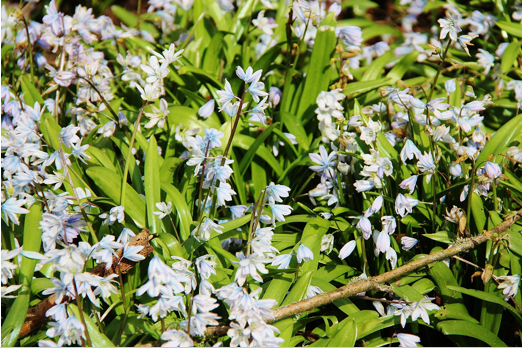
This genus is hardy and reliable. They do well in areas that are sunny early in the season, then become shady as the season ends. They are sometimes confused with bluebells but can be recognized by star shaped blooms that hold themselves more upright than the nodding blossoms of the bluebell.
| S. bifolia | The earliest flowering. Florescence is usually mid-blue, but there are also pink and white varieties. |
| S. siberica | The best known of the scilla, and the most hardy (Zones 1 – 8), offers a deep, true-blue flower. |
Tulip Species (Tulipa)
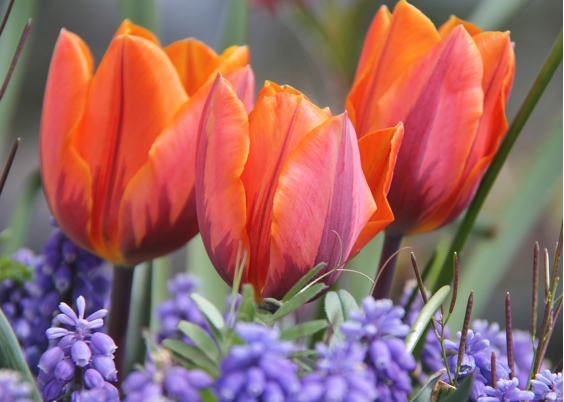
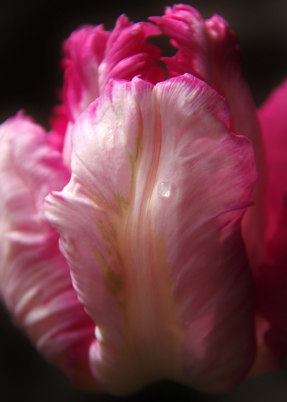
The modern hybrid tulips need sun as well and a winter freeze to maintain vigour. The earlier, smaller and shorter stemmed species (non-hybrid) tulips can be planted under deciduous trees or on the verges of sunny pathways as they tolerate some shade or dappled shade. Though smaller, their blooms are no less beautiful and unique. Tulips are known as ‘deer candy’ and get eaten very quickly, but many gardeners report that deer leave the species types alone.
| T. bakeri | Blossoms are similar to T. saxatilis but appear in clusters rather than singly. The first of three species that tolerates warmer winters, blooming mid-season. |
| T. kaufmanniana | The original lily-flowered tulip. Creamy yellow-white blooms with a red stripe open flat in the sun. |
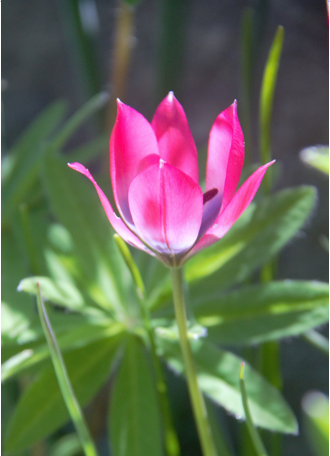
| T. pulchella | Needing a winter chill and good drainage, it is only 4 inches, yet produces vibrant purplish pink or hot pink blooms that stand out against the dark mulch as early as February. |
| T. saxatilis | Another species tolerant of warmer winters, its deep yellow-centered lilac blossoms are scented. |
| T. sylvestris | This late bloomer with butter yellow blossoms is the third in the group that tolerates a mild winter. |
Terms Used for Sun and Shade
- Full sun: At least 6 hours beginning at 10AM, continuing through until approximately 4PM.
- Part sun
- a): Morning between dawn and 2:00PM, then dappled or full shade in afternoon or evening. Most plants in this group do best in afternoon with dappled light.
- b): Dappled or full shade until noon, then full sun in afternoon through evening. This is often treated as full sun when there is more than four afternoon hours of sun, even if evening is shady, because this is when sun is brightest and hottest.
- c): This is seasonal sun, and for bulbs, refers to those earlier bloomers that thrive under deciduous trees then need their dappled shade canopy during their dormant season. These are best planted in the circle of mulch within the drip line so their greenery is not mowed down when the grass begins to grow.
- Shade
- a): Dappled sun/shade all day. It will vary in brightness but does not offer unprotected ground.
- b): Very few bulbs survive in true, full shade. Most of them are bog plants.
Sources
- A-Z Encyclopedia of Garden Plants, Canadian Edition, Eds., Brikell, Roles, and Cole, Dorling Kindersley, Ltd, Toronto ON, Canada, 2004.
- Bulbs for All Seasons, Edinger, Lang, Sunset Publishing, Menlo Park CA, 1999.
- Bulbs, the Four Seasons: a Guide to Selecting & Growing Bulbs All Year Round, Brian Matthew, Pavilion Books, London UK 1998
- Gardening With Native Wildflowers, Jones, Jr., Foote, Timber Press, Portland, Oregon, 1999
- Lois Hole’s Favorite Bulbs, Hole’s Publishing, St. Albert, Alberta, Canada, 2003.
- The New Flower Expert, Millennium Edition, Hessayon, Transworld Publishers, London, UK, 1999.
- The Woodland Garden: Planting in Harmony with Nature, Forster & Downie, Rain Coast Books, Vancouver, BC, 1999.
- BBC Gardeners World Magazine, September, 2018
- www.phoenixperennials.com
- www.gardenia.net
- www.paficibulbsociety.org
- www.RHS.org.uk (Royal Horticultural Society of the UK)
- www.gardenia.net/guides/
- linnet.geog.ubc.ca/biodiversity/eflora/ (E-flora BC atlas)
© J. Canning, 2010, 2021, 2026