 Vancouver Island Master Gardeners

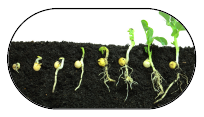
As seeds age, they lose their viability. Commercial packages generally indicate the germination rate for the year for which the seeds were sold (eg. 80%) meaning that, under good conditions, 8 of 10 seeds will germinate. Tables are readily available to indicate average seed life expectancy. For instance, corn has a life expectancy of 2 years under good storage conditions, while squashes and pumpkins may last 5 to 7 years.
If you are not sure, you can test your seeds for viability using a germination test. It is best to start the germination tests in January so you are prepared and know which seeds you need to purchase.
How do I Perform a Germination Test?
- Fold paper towel into 2 layers and label paper with non-running ink with the name of the seeds you want to test.
- Moisten paper – moist but not wet.
- Place 10 seeds onto paper with lots of space between the seeds – 1-2 cm.
- Place moist paper towel into a Ziploc bag.
- Close Ziploc bag and place in a warm, dark place – 18-24 °C.
- Carefully, so you don’t dislodge seeds, open bag daily to let in air. Reclose to ensure consistent moisture content.
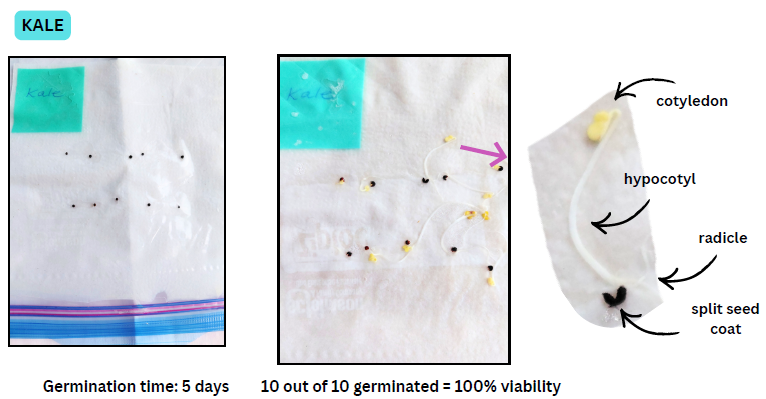
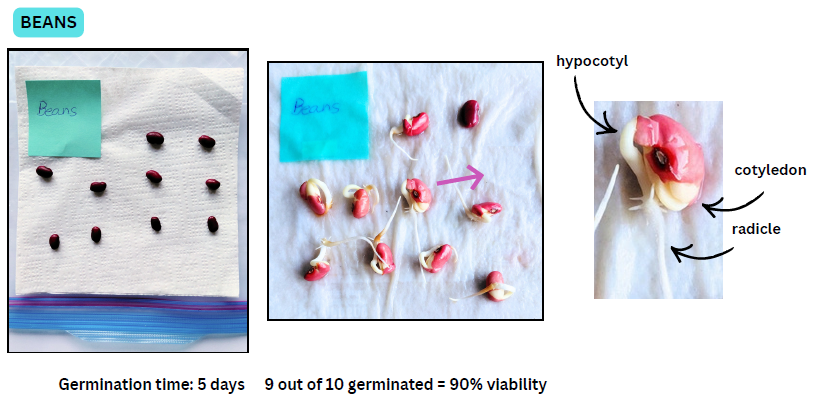
- Observe germination. Seeds have germinated when the cotyledons have unfolded and tips of true leaves are just showing.
- This process may take 1-2 weeks depending upon the seed type.
If 7 of the 10 seeds germinate, you have 70% germination = not bad. If only 3 germinate, you might consider getting new seeds or seeding more heavily than you would normally.
Resources
- Gilkeson, L. 2018. Backyard Bounty. 2nd Ed. Gabriola Island, BC: New Society Publishers.
- University of Illinois Extension. Will my seeds grow? https://extension.illinois.edu/sites/default/files/seed_viability.pdf
- University of Nebraska Lincoln. 2025. Vegetable garden seed storage and germination results. https://extensionpubs.unl.edu/publication/g2090/2011/pdf/view/g2090-2011.pdf
Vancouver Island Master Gardeners
Vancouver Island Master Gardeners are local volunteers who educate the gardening public with current, science-based and environmentally responsible horticultural information. As a chapter of the Master Gardeners Association of BC (MGABC), our program and priorities shape healthy communities and a healthy planet.