
Four Seasons of Bulbs for Woodlands and Shade
by Jo-Ann Canning
The class of plants called geophytes have five different subterranean storage organs that evolved to help them survive unpredictable weather patterns at the edges of the world’s many growing zones. We call them bulbs. They are all perennials. The key to growing bulbs is to give them the optimal dormant conditions where their unique storage organs have a chance to replenish themselves. Notes on right-plant-right-place in the lists refer more to this aspect than of their blooming seasons.
The following autumn bulbs are the most common offerings in garden centres:
Autumn Crocus Species (Colchicum)
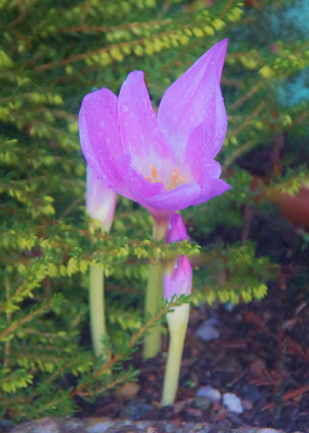
This is the autumn crocus, also called meadow saffron. It is not a crocus which is a member of the iris family, but is in the lily family, and is not a source of the herb saffron. It offers greenery in spring that dies back in summer then blooms from September through October on bare stems. Although it will tolerate a wide range of soils, it needs reliable drainage with some moisture all year. Be sure to plant it where it will get a nip of frost or it will not truly naturalize. Gravel paths or cement walkways tend to get colder than the surroundings, so it is often healthiest as well as showiest here. There are several hybrids to choose from for coloured blossoms.
| C. autumnale | This species is the quickest to naturalize. Plant in a sheltered spot as both pink and white flowered cultivars’ blossoms do not stand up well to wind and rain. |
| C. speciosum | This one has the largest and most weather resistant blooms. It is also the earliest, offering large pinkish lavender, chalice-shaped flowers. |
Crocus Species (Crocus)
Shaped like their springtime cousins, these crocus bloom in autumn, and offer greens only in Spring. All are available at the very beginning of the autumn buying season and should be planted immediately. Within a month, they will bloom.
| C. cartwrightianus | The blue or white blossoms are thought to be a wild progenitor of the Saffron crocus. |
| C. pulchellus | The earliest blooming, beginning in September. Violet blossoms with dark blue veins are quite showy. |
| C. sativus | This is the Saffron crocus. The stigmas are the source of saffron, the most expensive herb in the world. |
| C. tournefortii | The pale lilac blooms won this species the Royal Horticultural Society Award of Merit. |
Hardy Cyclamen Species (Cyclamen)
The hardy cyclamen are very satisfying shade plants with varied flowers and foliage. As long as there is plenty of leaf mould to feed them they naturalize easily under deciduous trees, tall shrubs, or on a shaded scree or rockery. Hardy cyclamen need a more alkaline soil, so top the leaf mould with at least two inches of #1 turkey grit, a type of calcium-rich gravel found in feed stores. All cyclamen self-sow. Let the seed pods develop and drop around the parent plant. When new ones emerge you can leave them to form a ground cover or move some to another location. Note: this is not the florist’s cyclamen, a strictly indoor plant that will not endure frost.
| C. coum | The hardiest and most reliable of the cyclamen, it can bloom in early autumn, often blooms all winter. |
| C. hederifolium | An earlier bloomer whose ivy shaped foliage is exquisitely marbled with white and silver. |
Autumn Snowflake (Acis autumnale)
Like its spring-flowering cousins, this bulb has nodding white flowers. Instead of the green spotted tips, it has a red-tinged base. See the spring group for cultivation needs.
Toad Lily Species (Tricyrtis)
When planted in humus rich soil the toad lily is very happy in deep or partial shade. It blooms from early to late autumn on a slender but sturdy stalk up to 90cm / 32 inches high.
| T. formosana | From early (around Labour Day) through late autumn it treats us with pink or magenta speckled stars. |
| T. hirta | This Japanese native begins flowering earlier, often in late summer, and lasts through autumn. |
Terms Used for Sun and Shade
- Full sun: At least 6 hours beginning at 10AM, continuing through until approximately 4PM.
- Part sun
- a): Morning between dawn and 2:00PM, then dappled or full shade in afternoon or evening. Most plants in this group do best in afternoon with dappled light.
- b): Dappled or full shade until noon, then full sun in afternoon through evening. This is often treated as full sun when there is more than four afternoon hours of sun, even if evening is shady, because this is when sun is brightest and hottest.
- c): This is seasonal sun, and for bulbs, refers to those earlier bloomers that thrive under deciduous trees then need their dappled shade canopy during their dormant season. These are best planted in the circle of mulch within the drip line so their greenery is not mowed down when the grass begins to grow.
- Shade
- a): Dappled sun/shade all day. It will vary in brightness but does not offer unprotected ground.
- b): Very few bulbs survive in true, full shade. Most of them are bog plants.
Sources
- A-Z Encyclopedia of Garden Plants, Canadian Edition, Eds., Brikell, Roles, and Cole, Dorling Kindersley, Ltd, Toronto ON, Canada, 2004.
- Bulbs for All Seasons, Edinger, Lang, Sunset Publishing, Menlo Park CA, 1999.
- Bulbs, the Four Seasons: a Guide to Selecting & Growing Bulbs All Year Round, Brian Matthew, Pavilion Books, London UK 1998
- Gardening With Native Wildflowers, Jones, Jr., Foote, Timber Press, Portland, Oregon, 1999
- Lois Hole’s Favorite Bulbs, Hole’s Publishing, St. Albert, Alberta, Canada, 2003.
- The New Flower Expert, Millennium Edition, Hessayon, Transworld Publishers, London, UK, 1999.
- The Woodland Garden: Planting in Harmony with Nature, Forster & Downie, Rain Coast Books, Vancouver, BC, 1999.
- BBC Gardeners World Magazine, September, 2018
- www.phoenixperennials.com
- www.gardenia.net
- www.paficibulbsociety.org
- www.RHS.org.uk (Royal Horticultural Society of the UK)
- www.gardenia.net/guides/
- linnet.geog.ubc.ca/biodiversity/eflora/ (E-flora BC atlas)
© J. Canning, 2010, 2021, 2026