
Four Seasons of Bulbs for Woodlands and Shade
by Jo-Ann Canning
The class of plants called geophytes have five different subterranean storage organs that evolved to help them survive unpredictable weather patterns at the edges of the world’s many growing zones. We call them bulbs. They are all perennials. The key to growing bulbs is to give them the optimal dormant conditions where their unique storage organs have a chance to replenish themselves. Notes on right-plant-right-place in the lists refer more to this aspect than of their blooming seasons.
For gardeners in the Pacific Northwest, spring flowers begin in February, in late winter, even in a mild January when Galanthus and species Crocus brave the soggy soil. Hardy blossoms brighten the dark days and coax out the early wild pollinators. For gardeners inland and at altitude, know your last frost date, soil temperature and moisture content in late winter through the frost date as these are key to early blooms. Sometimes ‘three feet to the right” makes two to three weeks difference in both emergence and flowering.
The following winter bulbs are the most common offerings in garden centres:
- Italian Arum or Lords-and-Ladies (Arum italicum)
- Glory-of-the-Snow (Chionodoxa luciliae)
- Crocus Species (Crocus)
- Cyclamen Species (Cyclamen spp)
- Winter Aconite (Eranthis hyemalis)
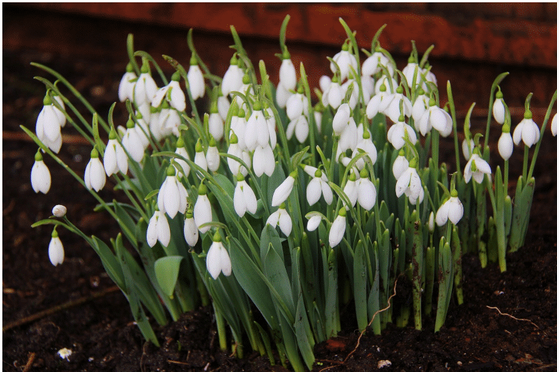
- Snowdrop Species (Galanthus)
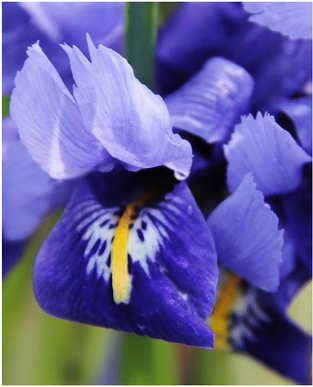
- Dwarf Iris (Iris reticulata)
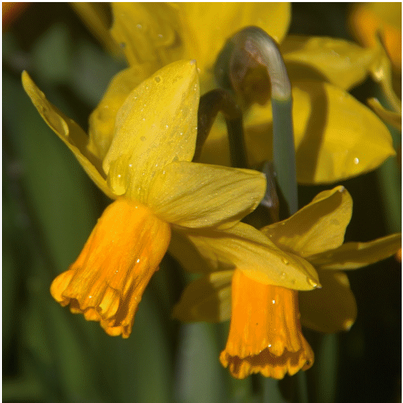
- Daffodils Early Blooming Species (Narcissus)
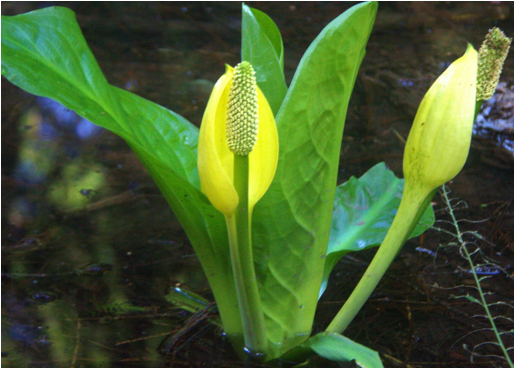
- Skunk Cabbage (Symplocarpus foetidus)
Italian Arum or Lords-and-Ladies (Arum italicum)
A four-season plant in mild winters, this is a true shade lover. At maturity it can be as tall as 90 cm (36 inches), a very tall specimen in the shade garden. The sword-shaped, veined leaves sprout in late autumn or early winter, and at maturity will be 30 cm (12 inches) long atop a stem approximately the same length. White flowers (called spathes) appear in spring and last through summer. The leaves die back in summer, as elongated clusters of red fruit form and mature from early through mid autumn. Sometimes slow to establish, A. Italicum can remain small for a year or so but adds a dimension to the woodland that is unique among bulbs.
Warning: More and more gardeners in milder regions are reporting that this species is becoming invasive, so be advised.
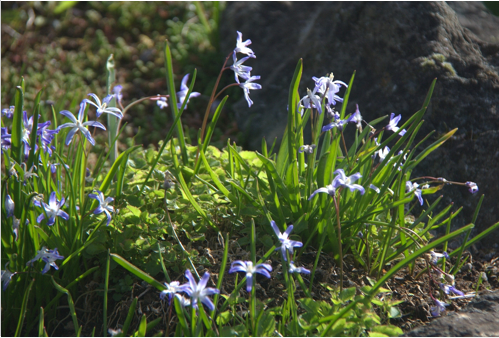
Glory-of-the-Snow (Chionodoxa luciliae)
In its native Greece, this little flower blooms in shades from deep blue through pink to white at the edges of the mountain snow banks. A versatile bulb that does well under deciduous shrubs where sun hits ground in early season, in rockery or along pathways. It thrives best in humus-rich soil. Blooms through early spring.
Crocus Species (Crocus)
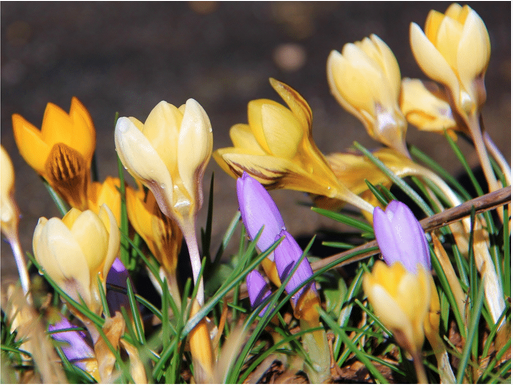
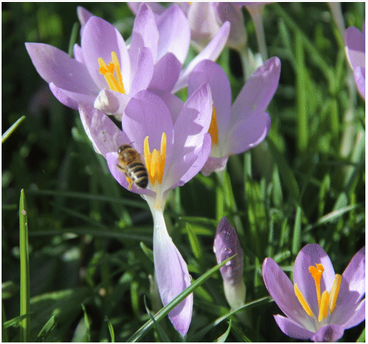
There are over 80 species, and many hybrid cultivars. Crocus are happiest in sunny, open locations, but the following tolerate dappled sun and part shade quite well. There are many places to plant them, especially where deciduous shrubs and trees are not yet leafed out. The wild or ‘species’ bulbs produce smaller and often earlier blooms than the big Dutch hybrids but produce more florescence from each corm. All crocus are long-lived plants that naturalize easily into clumps and drifts. The following species types are the easiest species to grow in all conditions. See the listing for notes on those that bloom later, more into real spring.
| C. ancyrensis | Very early yellow. |
| C. biflorus | The familiar lilac or blue & white striped blossom. |
| C. chrysanthus | The true species type, yellow-orange, and scented. There are several selections, with many named cultivars in yellow, white and blues. |
| C. tommasinianus | Another species variety, along C. chrysanthus. It is a favourite of early wild pollinators like bumblebees. It blooms in violet or purple, and is the most prolific and the easiest to grow. It also spreads readily from seed. Space corms over the whole area, and they will fill it all in very quickly. |
Cyclamen Species (Cyclamen spp)
This group of tuberous plants are the stars of autumn through late winter, valued for their interesting leaves as much as their blooms. True ground covers, they grow only 5-10cm/2-4 inches. There are earlier and later-blooming (true spring and early autumn) which are mentioned in those season’s lists. The winter list:
| C. coum | The hardiest species. It brings colour with leaves and flowers to winter under deciduous trees. |
| C. balearicum | Has the least showy flowers but offers the most interesting multi-coloured leaves. |
| C. libanoticum | Sports the largest, pink flowers and the most plain coloured leaves. |
| C. pseudibericum | Has red blossoms that are also fragrant, with silver and green patterns of the leaves. |
| C. trocopteranthum | Is related to C. coum making it hardy. It also has fragrant blossoms ranging from red to white, with silvery-patterned leaves. |
Winter Aconite (Eranthis hyemalis)
The popular winter aconite is a very early, bright yellow bloomer. It is good in rock gardens and as under-plantings where the sun shines in spring then becomes shady for the rest of the year. Good combined with later blooming bulbs like crocus, narcissus, etc., for continuous colour from early to late. Choose an area that never completely dries out or (if the tubers survive at all) you will never get a good carpet over the years.
Snowdrop Species (Galanthus)
Shy, nodding snow drops are among our earliest spring flowers. Their bright white, elongated bells are great with crocus, or beneath taller fritillaries. Native to colder climates, they maintain long-term vigour better in areas with a few winter nights that drop below freezing. The newer hybrids offer fancier and some double blooms.
| G. elwesii | Adapted to mild winters, the florescence is more egg shaped and infused with more green than other cultivars. A good choice if you like the look and rarely get a hard freeze. |
Dwarf Iris (Iris reticulata)
Often the first to appear in the early garden, its blue blossoms are only 13-15 cm / 3-5 inches tall.
Daffodils Early Blooming Species (Narcissus)
Most narcissus, the yellow-trumpet forms often called daffodils, are spring-bloomers, and most want full sun. The following are not only very early, they are more tolerant of part shade/sun and in marginal climates, especially when planted facing east or south. Most earliest are in the cyclamineus group, the miniatures, which are less than 20 cm / 12 inches. See the spring group for more genus information.
| N. speudonarcissus | The wild narcissus blooms are fully yellow-blossomed and bloom as early as February. It will spread by seed as well as bulbils. |
| Narcissus ‘Ice Follies’ | Another species variety, it shows in white perianth with a short yellow corona. |
| Narcissus ‘February Gold’ | This variety has a sulphur yellow recurved perianth and corona. Like most species types, it naturalizes easily. It is the most tolerant of shade and heavy, damp soil. |
| Narcissus ‘Tête à Tête’ | Similar to February gold, it has a longer corona and is the smallest early, at15-20cm / 6-8 in. |
| Narcissus ‘Rip Van Winkle’ and ‘Early Bride’ | These bridge the seasons, and will bloom early March if in a protected spot. |
Skunk Cabbage (Symplocarpus foetidus)
The skunk cabbage, a native to Pacific coastal areas, thrives in boggy ground. It pops up singly then spreads into clumps of 30 cm / 1ft plants with bright green leaves 40-55cm / 16-22 inches wide. The butter yellow spathes in late February to early March are 10-15 cm / 4-5 inches high. Although it does indeed smell ‘skunky’ you must be very close to catch a whiff of it.
Terms Used for Sun and Shade
- Full sun: At least 6 hours beginning at 10AM, continuing through until approximately 4PM.
- Part sun
- a): Morning between dawn and 2:00PM, then dappled or full shade in afternoon or evening. Most plants in this group do best in afternoon with dappled light.
- b): Dappled or full shade until noon, then full sun in afternoon through evening. This is often treated as full sun when there is more than four afternoon hours of sun, even if evening is shady, because this is when sun is brightest and hottest.
- c): This is seasonal sun, and for bulbs, refers to those earlier bloomers that thrive under deciduous trees then need their dappled shade canopy during their dormant season. These are best planted in the circle of mulch within the drip line so their greenery is not mowed down when the grass begins to grow.
- Shade
- a): Dappled sun/shade all day. It will vary in brightness but does not offer unprotected ground.
- b): Very few bulbs survive in true, full shade. Most of them are bog plants.
Sources
- A-Z Encyclopedia of Garden Plants, Canadian Edition, Eds., Brikell, Roles, and Cole, Dorling Kindersley, Ltd, Toronto ON, Canada, 2004.
- Bulbs for All Seasons, Edinger, Lang, Sunset Publishing, Menlo Park CA, 1999.
- Bulbs, the Four Seasons: a Guide to Selecting & Growing Bulbs All Year Round, Brian Matthew, Pavilion Books, London UK 1998
- Gardening With Native Wildflowers, Jones, Jr., Foote, Timber Press, Portland, Oregon, 1999
- Lois Hole’s Favorite Bulbs, Hole’s Publishing, St. Albert, Alberta, Canada, 2003.
- The New Flower Expert, Millennium Edition, Hessayon, Transworld Publishers, London, UK, 1999.
- The Woodland Garden: Planting in Harmony with Nature, Forster & Downie, Rain Coast Books, Vancouver, BC, 1999.
- BBC Gardeners World Magazine, September, 2018
- www.phoenixperennials.com
- www.gardenia.net
- www.paficibulbsociety.org
- www.RHS.org.uk (Royal Horticultural Society of the UK)
- www.gardenia.net/guides/
- linnet.geog.ubc.ca/biodiversity/eflora/ (E-flora BC atlas)
© J. Canning, 2010, 2021, 2026