 Vancouver Island Master Gardeners
by Jacquelin Sherk
This summer I had the privilege of participating in a hands-on workshop to control an infestation of that beautiful but dangerous invader, yellow flag iris (Iris pseudacorus, aka YFI). As members of the Cowichan Lake and River Stewardship Society, we were able to secure a grant to hire plant biologist and weed scientist, Catherine Tarasoff of Thompson Rivers University. Dr. Tarasoff has studied and investigated methods of controlling this highly invasive non-native plant, which has spread across Canada and is classified as a noxious weed in our province. It is a remarkably adaptable plant and, although it prefers riparian areas, it can also survive in terrestrial and aquatic zones.
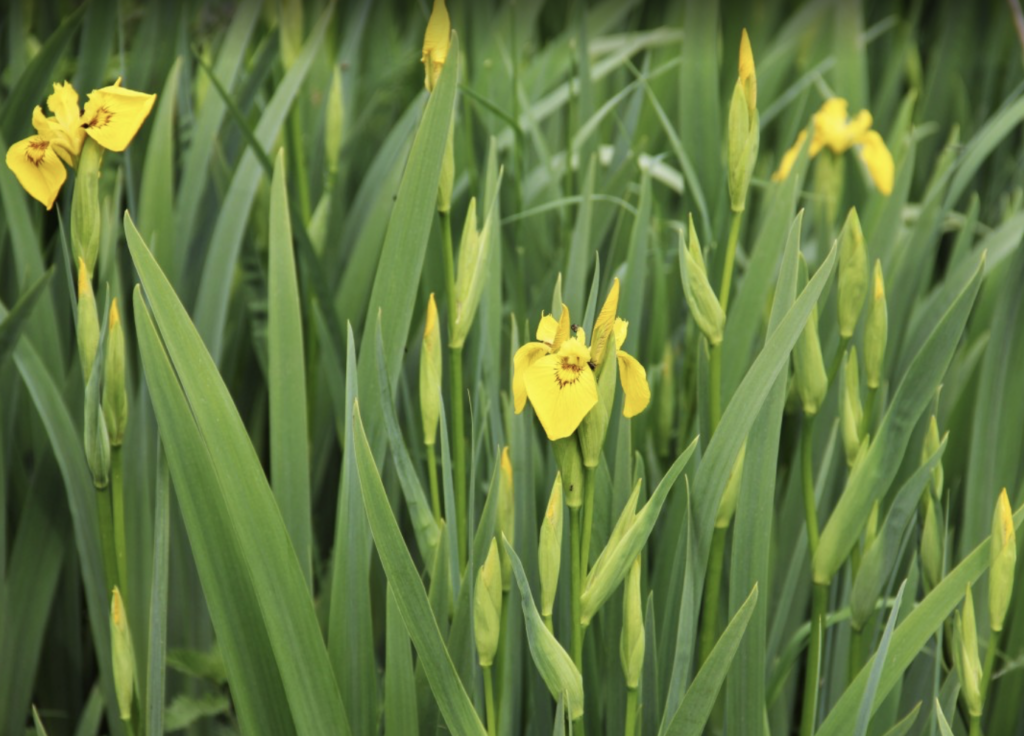
When in bloom, yellow flag iris is a real stand-out with its large, showy, bright yellow flowers. At its base it forms unusually large rhizomes that develop extensive mats, or “shelves”, as Catherine referred to them, a foot or more in thickness. Once established, they form a dense, connected colony that can overtake shorelines, wetlands, ditches and streams, out-competing native riparian plants and altering the ecology of important wetland and estuarine areas.
YFI can also spread through its large and extremely viable floating seeds. Once released, they will float downstream and lodge along the shoreline, where they begin to establish and grow a new colony. Digging is not recommended except for small infestations because, like some other plants, YFI can regenerate from fragments of its rhizomes.
When not in bloom, it might be confused with our native broadleaf cat-tail (Typha latifolia) which also inhabits riparian areas. Catherine showed us some useful clues that differentiate these two lookalikes: YFI’s tall, sword-like leaves have a noticeably prominent raised central rib which cat-tail doesn’t, and YFI leaf bases have a reddish-purple hue. The leaves also arise in a distinctive fan-like arrangement, while cattail leaves emerge in a more circular arrangement.
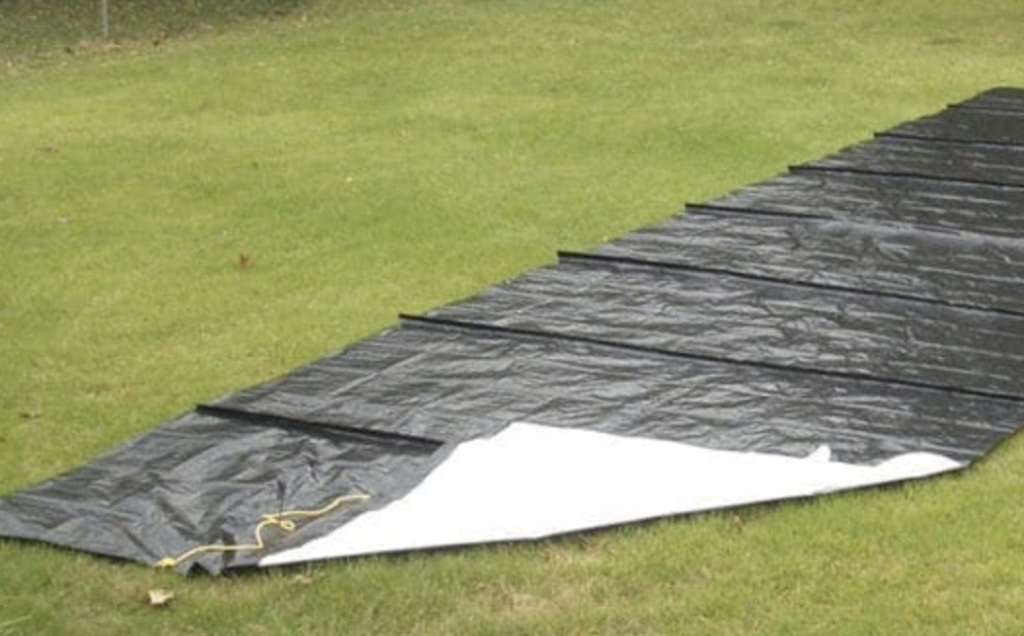
Our project took place in a riparian area in Youbou, where we counted on the low water levels of the lake in July to allow us to work along the shoreline. Our designated site was 10’ × 20’. First, we cut the foliage to the ground using loppers (chop and drop), then covered the area with a heavy, impermeable mat called a ‘benthic barrier’ which is a dense rubber mat designed to exclude light and restrict growth. (Benthic is a term that describes the bottom of a body of water.) This product is the same type that would be used in pond construction. The barrier was securely anchored using spikes and just about anything else we could throw on it to keep it weighted down. It is now intended to remain in place for an extended period of at least a year, and likely longer we were told!
Under the barrier, deprived of light, the iris can no longer photosynthesize and must survive on energy stored in its rhizomes. With little oxygen the rhizomes switch to an alternative form of energy production called anaerobic metabolism. Although YFI is adapted to low-oxygen conditions, this process produces toxic compounds which can normally be dispersed through the plant growing shoots, but without the ability to grow new shoots beneath the barrier, there is no escape. The toxins accumulate and the rhizomes eventually die. We will test them next year to ascertain evidence of accelerated rot before removing the barrier.
Our small pilot project was an opportunity to learn whether a method developed through scientific research could provide a practical tool for local stewardship groups. For a plant that is so invasive, pervasive and difficult to control, finding effective methods of removal is increasingly important to protect the ecological integrity of our beautiful shorelines for everyone and everything that lives on, in or near them!