
“Prune to natural form so your work becomes invisible.”
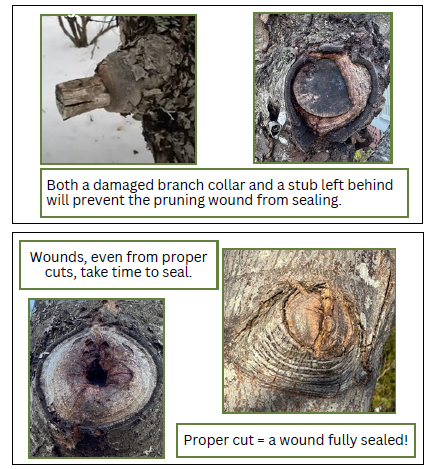
Pruning is wounding and, unlike animal wounds, the damage done to trees and shrubs cannot be reversed or “healed” by the replacement of the injured tissue. Trees simply wall off decay, controlling its spread long enough so that new wood added to the outside of the tree can take over the functions of wood rotting away. Pruning wounds don’t HEAL, they SEAL.
Types of Cuts
1. Heading Cut
Shorten trunks, branches, or twigs by heading back, tipping, topping or shearing, usually causing an explosion of growth in the remaining branch.
A. Selective Cuts
Choose particular branches to individually cut:
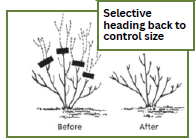
- Heading back – Controls size. Think hydrangeas and roses.
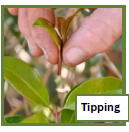
- Tipping – Pinching out the growing tip encourages bushy growth. Think chrysanthemums for more blooms or pepper plants for more peppers.
B. Non-Selective Cuts
Whacking back to no place in particular:
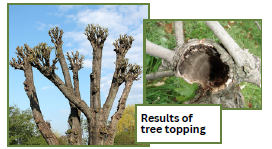
- Topping – Ruins the natural form of the plant and opens the main trunk to rot, disease, and eventual death. Just say no!
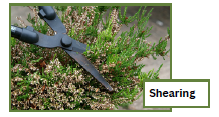
- Shearing – Suitable for hedges and some small shrubs. Think heather or lavender. When done on most trees and shrubs, growth habit changes to many thin branches with many small leaves, resulting in a lollipop look.
2. Branch Removal Cut
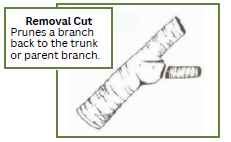
Removes a branch or twig completely back to its point of attachment to a larger branch or the trunk.
Maintains the natural form and growth habit of the plant.
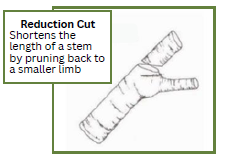
3. Reduction Cut
Removes a section from the end of a branch, leaving a smaller branch behind.
Used to control size and/or redirect growth, usually up and out.
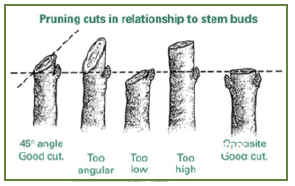
How to Make a Proper Branch Removal Cut
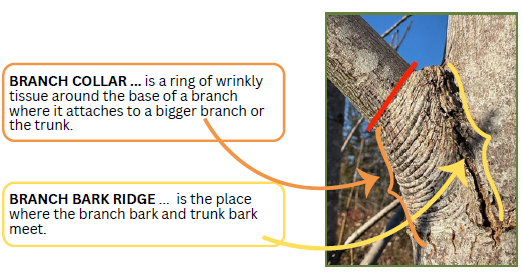
1. What Do I Look For?
2. Where Should I Cut?
Cut close to and parallel to the Branch Collar (see RED line).
Do not cut into the Branch Collar! The branch collar tissue closes the pruning wound to prevent infection and decay.
Do not leave a stub! It will prevent the branch collar from closing the wound.
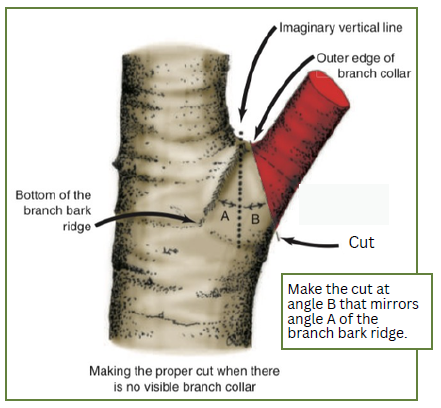
3. What if the Branch Collar is not Obvious?
4. What Happens if the Cut is not Correct?
Resources
- Fogerty, E. 2013. Pruning Flowering Shrubs. Cooperative Extension Fact Sheet FS1221. New Jersey Agricultural Experiment Station. Rutgers, The State University of New Jersey.https://njaes.rutgers.edu/fs1221/
- Longfellow’s Blog. 2021. Winter pruning. Longfellow’s Greenhouses.https://longfellowsgreenhouses.com/winter-pruning/
- Australian Plants on Line. 2024. How to Dip-Prune. https://www.australianplantsonline.com.au/blog/post/tip-pruning
- Elite Tree Care. 2023. What’s tree topping & why it is bad. https://www.elitetreecare.com/2023/12/tree-topping-results/
- Dutton, T.J. 2025. Topping is Bad. Crown, Root & Soil Tree Preservation & Sustainable Landscape Plant Care. https://www.crownrootandsoil.com/?p=160
- BBC Gardener’s World Magazine. 2024. March 3rd Ed. How to grow & care for a healthy plant. https://www.gardenersworld.com/how-to/grow-plants/how-to-grow-heather-plant/
- Friend of Trees (FoT). 2025. How to prune a tree. https://friendsoftrees.org/news-resources/tree-pruning/
- Gilman, E.F. 2012. An Illustrated Guide to Pruning. 3rd Ed. NY: Delmar, Cengage Learning. ISBN-13: 978-1-111-30730-1. Image on page 92.
- Myers, M. 2020. Proper Pruning Techniques. Urban Forest Dwellers. Link is no longer available.
Vancouver Island Master Gardeners
Vancouver Island Master Gardeners are local volunteers who educate the gardening public with current, science-based and environmentally responsible horticultural information. As a chapter of the Master Gardeners Association of BC (MGABC), our program and priorities shape healthy communities and a healthy planet.