
Over time, research has changed our understanding of plant health and physiology, resulting in updated recommendations for transplanting.
Digging the Hole
Dig the hole wide enough to accommodate the spread out roots.
Placing the Plant
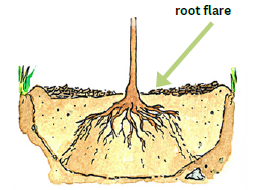
Place the plant on a mound in the centre of the hole just deep enough to position the root flare slightly above the soil level.
- Add soil to fill the hole to about halfway.
- Water well to wash the soil down and around the bare roots.
- Continue adding soil and watering until soil is level with the root flare.
Understanding the Root Flare
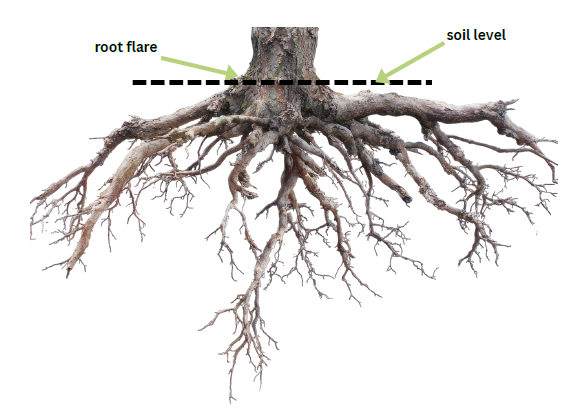
The root flare is the place on the trunk of a tree or shrub where the topmost root emerges from the trunk.
- The root flare should always be at soil level.
- Root respiration takes place within a few inches of the soil surface where oxygen from the air can passively diffuse down to the roots.
- Roots planted too deep have restricted respiration, leading to root injury or the slow suffocation and death of the plant.
- Bark is typically above ground and when buried too deep and kept moist, it tends to rot creating entry points for disease and insects.
Planting in Native Soil
Reasons for not amending the soil:
- Amending with peat, compost, sand, etc., creates a pocket of soil different from the surrounding native soil, which can discourage new roots from extending into it.
- Fertilizing at planting is unnecessary and may even burn new or recently disturbed roots. Wait at least a few months to a year.
- As organic soil amendments decompose and disappear, the soil around the plant will subside causing the plant to settle below grade.
Staking Only if Necessary to Keep Plant Upright
Necessary only when:
- A tree has a small root system that can’t physically support the larger, above-ground growth.
- The stem/trunk bends excessively when not supported.
- The site is very windy and trees will be uprooted if they are not supported.
How to Stake:
- Stem/trunk attachment materials should be wide, soft and flexible to prevent damage to the tree.
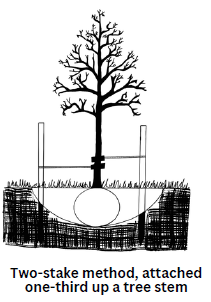
- Place the strap(s) at the lowest point on the trunk where the tree can be held upright. This will let the trunk move a bit with the wind and build a stronger trunk and roots.
- As a rule of thumb, use only enough stakes to keep the tree upright and stable. One may be enough for smaller trees, while large ones may need up to four.
- Leave staking in place for one year.
Note: Staking too high, too tight, and/or too long results in tall but weak stems/trunks.
Pruning
Be patient over the next season while the roots reestablish themselves in their new home.
- Hold off pruning for the first full year. The leaves are the plant’s food factory and you don’t want to compromise its food producing capacity while new roots are growing and getting established.
Remember: The first year they sleep, the second year they creep, the third year they leap.
Resources
- Arbor Day Foundation. 2025. How to Plant Bare-Root Trees. https://www.arborday.org/planting-your-tree/how-plant-bare-root-trees
- Johnson, G.R. 2020. Staking and Guying Trees. University of Minnesota Extension. https://extension.umn.edu/planting-and-growing-guides/staking-and-guying-trees
- Steil, A. 2025. How to Plant Bare Root Trees. Iowa State University Extension and Outreach. https://yardandgarden.extension.iastate.edu/how-to/how-plant-bare-root-trees
- Wagner, J. 2016. Planting Bare Root Plants. East Multnomah Soil & Water Conservation District. https://cdn11.bigcommerce.com/s-qttyo32dlj/product_images/uploaded_images/planting-bare-root-plants-blog.jpg

Vancouver Island Master Gardeners
Vancouver Island Master Gardeners are local volunteers who educate the gardening public with current, science-based and environmentally responsible horticultural information. As a chapter of the Master Gardeners Association of BC (MGABC), our program and priorities shape healthy communities and a healthy planet.