

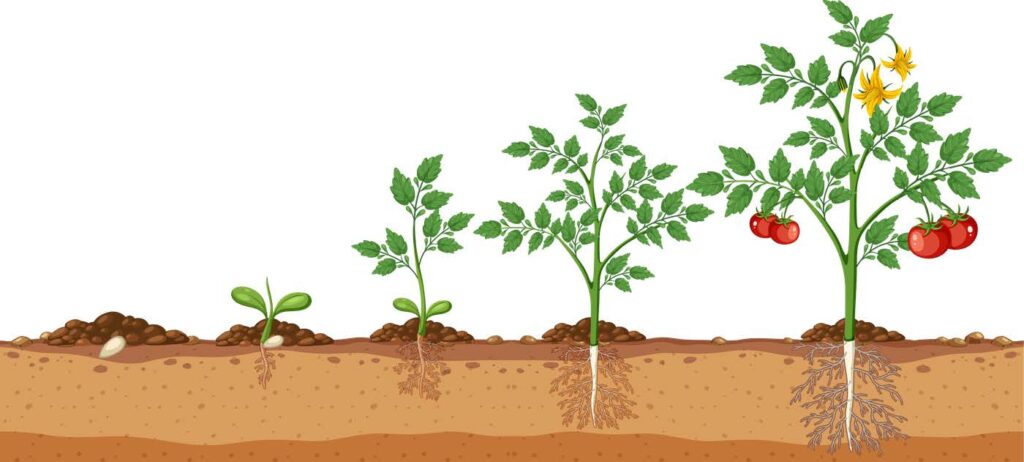
Tomatoes are popular and rewarding vegetables to grow in a vegetable garden. Following are a few points to ensure a bountiful harvest.
When Can I Plant My Transplants?
Tomatoes can be planted out once the nighttime temperatures are consistently over 10º C.
Is There a Specific Way to Plant My Tomato Starts into the Garden?
Before planting, ensure the soil is loose, well-drained, and free from weeds. Consider incorporating well-rotted compost into the rooting zone a week before planting.
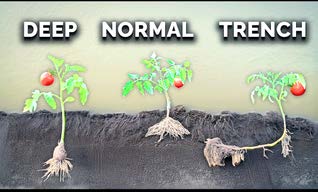
There are two common ways to plant tomatoes into the ground.
Method #1: Vertical Planting
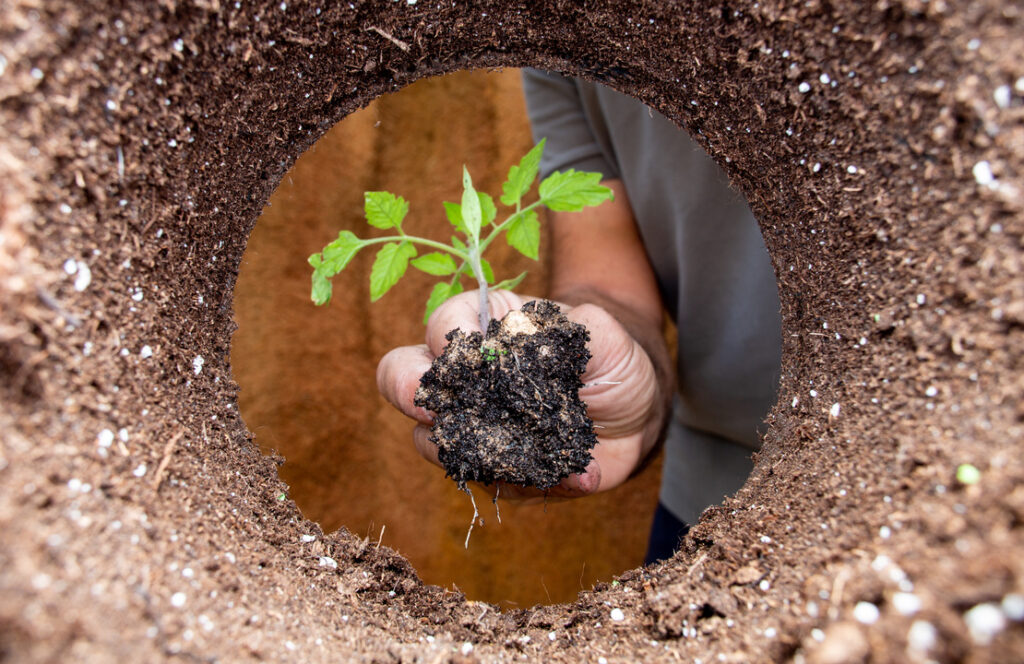
- Place the root ball into the planting hole until the lower leaves are touching the soil. Roots will grow along the stem ensuring a strong root system.
- Water well to a depth of 12-18 inches (30-45 cm).
- Place seedlings 2 to 3 feet apart (0.9-1.2 m) to allow sufficient sun and avoid overcrowding.
- Place tomato cages or stakes into the ground at the time of planting.
Note: All varieties need support: determinate tomatoes can be staked or supported by a tomato cage while indeterminate tomatoes usually get too tall for tomato cages and are best supported with tall stakes.
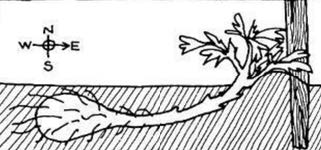
Method #2: Trench Planting
- Pinch off any yellow or dying leaves.
- Lay long leggy transplants in a trench 3-4 inches deep (8-10 cm).
- Bury the stems up to the first set of true leaves.
- Water well to reduce the shock of transplantation.
- Place tomato cages or stakes into the ground at the time of planting.
Note: View an excellent video on trench planting at Manitoba Master Gardener Association.
Should I do Anything with the Soil?
- Add 2-3 inches of well-rotted compost to the soil and mix in lightly. This will improve the soil structure, drainage, and moisture retention.
- Mulch with leaves or grass clippings to minimize weeds and improve soil moisture retention.
- Tomatoes are heavy feeders. A balanced organic fertilizer such as 4-4-4 or a tomato specific blend can be worked into the planting area to provide N-P-K and micro-nutrients. Do not add fresh manure or high N fertilizer.
- Water deeply and consistently to prevent blossom end rot. Amend with calcium if blossom end rot develops despite consistent watering.
Do I Need to Prune?
- Improve air circulation by pruning lightly and by removing any lower leaves or branches that are within 8-10 inches (20-25 cm) of the ground.
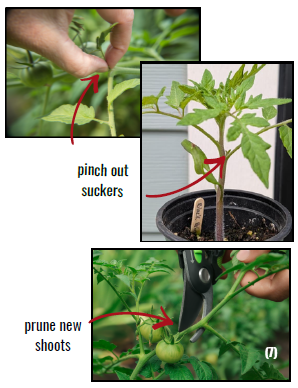
- For indeterminate tomatoes, pinch out suckers to control size and direct energy to making fruit. Prune off new shoots and flowers in late summer to help ripen existing fruit.
Tip: Tomato flowers are self-pollinating, assisted by wind. If the tomatoes are grown in a greenhouse, give the flowers a gentle shake in the middle of the day to help with pollination.
Resources
- Epic Gardening. 2025. What happens when you transplant tomatoes three different ways. https://www.youtube.com/@epicgardening.
- Epic Gardening. 2025. How to prune tomatoes for maximum yield and health. https://www.youtube.com/watch?v=q4IUhZMA9O0
- Hillock. D & E. Rebeck. 2017. Growing Tomatoes in the Home Garden. Oregon State University Extension. https://extension.okstate.edu/fact-sheets/growing-tomatoes-in-the-home-garden-2.html
- Manitoba Master Gardener Association. 2025. How to prune tomatoes. https://www.mgmanitoba.com/ask-an-mg/vegetables-and-fruits/#prune-tomatoes-video
- Manitoba Master Gardener Association. 2025. How to plant tomatoes – trench method. https://www.mgmanitoba.com/ask-an-mg/vegetables-and-fruits/#planting-tomatoes-video
- Nationals Gardening Association Editors. 2025. Trench & Vertical Tomato Planting Techniques. The National Gardening Association Learning Library. https://garden.org/learn/articles/view/360/Trench-Vertical-Tomato-Planting-Techniques
- The Creative Vegetable Gardener. 2015. Here’s a quick way to prune indeterminate tomatoes. https://www.creativevegetablegardener.com/pruning-indeterminate-tomatoes/
Vancouver Island Master Gardeners
Vancouver Island Master Gardeners are local volunteers who educate the gardening public with current, science-based and environmentally responsible horticultural information. As a chapter of the Master Gardeners Association of BC (MGABC), our program and priorities shape healthy communities and a healthy planet.