

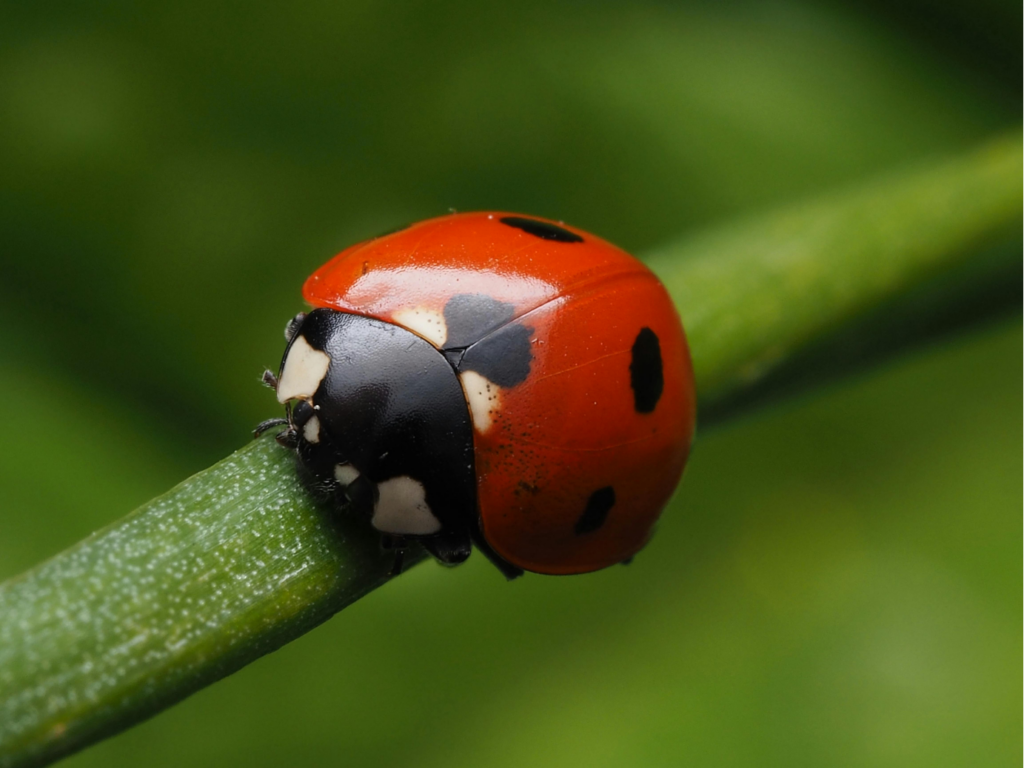
A wide variety of beneficial insects can be found on Vancouver Island and within the greater Pacific Northwest. These beneficial insects are key in supporting healthy garden ecosystems. And while most home gardeners are familiar with pollinators like bees, butterflies, wasps & flies, there are a whole host of other beneficial insects that act as natural enemies (aka biological control agents) of pest insects. This article focuses on these lesser known garden heroes including predatory insects, parasitoids, and those that do a combination of both.
Predatory Insects
Predatory insects capture and eat other bugs. In some species, both larvae and adults are predatory, while with other species, only the larvae and/or juvenile stages are predatory. Below are several examples of beneficial predatory insects that can be found on Vancouver Island and within the greater Pacific Northwest.
1. Aphid Midge
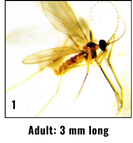
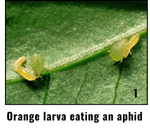
There is a single species of Aphid Midge in British Columbia. Adults lay eggs in aphid colonies and the orange larvae eat the aphids. Adults have some distinguishing adult features. They are delicate long-legged brown flies which are active at night and so rarely seen by home gardeners. Aphid midges overwinter as pupae in the soil and there are several generations produced each year.
2. Syrphid (Hover) Fly
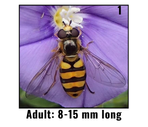
There are over 400 species of Syrphid Fly in the Pacific Northwest. Adults lay eggs on leaves with insect prey present and larvae feed primarily on aphids. There are several generations each year. The adult flies resemble ‘small yellow jackets’. Their identifying features are (1) short antennae, (2) large eyes (“ski goggle-like”) and (3) only 1 pair of wings. Syrphid flies hover before landing to feed on nectar and pollen. The larvae are flattened, legless maggots with tapered body and no distinct head. They range in colour from yellow to green to brown. The eggs are small, white and laid singly among aphids. Depending on species, syrphids can overwinter as either larvae, pupae or adults.
3. Lady Beetles (aka Ladybugs)
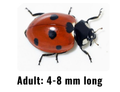
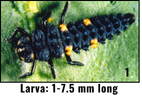
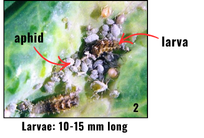
There are 12 species of Lady Beetles in British Columbia and many will vary in size, colour and pattern. Adult lady beetles lay eggs in aphid colonies where both the adults and larvae feed on aphids, whiteflies, scale insects, mealybugs and other soft-bodied insects. The adult lady beetles are most commonly black, red, orange-red to almost yellow and have coloured spots or markings on their back. Adults can overwinter and there is usually only one generation per year.
4. Minute Pirate Bugs, Big-Eyed Bugs
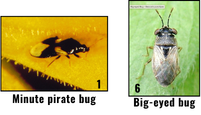
Adults of both Minute Pirate Bugs and Big-Eyed Bugs species are so tiny (2 to 3 mm) you may never see them. These feed on a variety of small, soft-bodied insects and eggs.
5. Lacewings
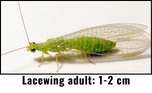
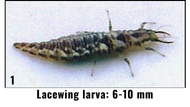
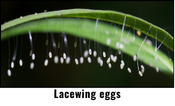
There are 36 brown and 28 green species of Lacewings in the Pacific Northwest. Adults lay eggs on long stalks on the undersides of leaves and branches. Green lacewings (larvae only) and brown lacewings (both adults and larvae) feed on aphids, spider mites, whiteflies, thrips, leafhoppers, scales, mealybugs, psyllids, small caterpillars, and insect eggs. Both adults and pupae can overwinter and there are up to 4 generations each year.
6. Stiletto Fly
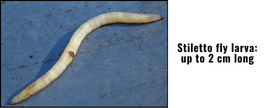
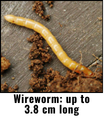
Note: Wireworms are the larvae of the click beetle that feed on root crops such as potatoes. The stiletto fly larvae closely resemble the wireworms except for colour.
There is a single species of Stiletto Fly in British Columbia that eats wireworms. Adults lay their eggs in soil near grass or grass-like plants. White larvae emerge from the eggs and feed on tan, orange or light brown wireworms in the soil. The larvae are legless with a tiny head and a very long, thin cylindrical body with tapered ends. The larvae mature, overwinter and produce only one generation per year.
7. Ground Beetles
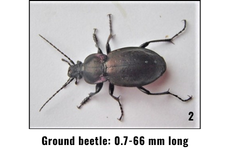
There are over 700 species of Ground Beetles in the Pacific Northwest. Both the eggs and larvae of ground beetles live entirely in the soil where they, along with the adults, feed on soil-dwelling pests such as caterpillars, cutworms, and slugs to name a few. Many will also feed on weed seeds. Adult ground beetles emerge from the soil in early summer and are active, primarily at night, until overwintering in the fall. All species of ground beetles thrive in mulched and undisturbed soil.
8. Rove Beetles
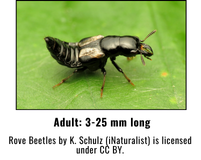
There are roughly 1000 species of Rove Beetles in the Pacific Northwest. The adults lay tiny eggs in soil rich in organic matter, decaying leaves or animal dung or compost. Rove beetles are generalists that feed on a variety of insect pests as well as
beneficial insects. The adults can be identified by their long abdomen that will curve upward when feeding or
disturbed. They can often be found under debris and rocks, near water, or in compost piles; they overwinter in protected environments.
9. Predatory Mites
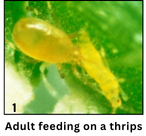
The eggs of beneficial Predatory Mites are opaque and oval, whereas pest mite eggs are round. Adult predatory mites feed on other tiny, plant-feeding pest mites like spider mites, thrips and fungus gnat larvae. The adults are also distinguished from their prey by their larger size, pear-shaped body and translucent coloration. They are very active and fast-moving compared to pest mites. These beneficial mites are also extremely tiny with adults measuring a mere 0.25-0.4 mm and with mature nymphs of these species being slightly smaller. Predatory mites overwinter as adults, becoming active in the spring, to produce several generations per summer depending on the temperature.
Parasitoid Insects
Parasitoid insects are those species that lay their eggs on or in a host. Depending on the species, eggs may be laid on any stage of the host: larvae, nymphs, pupae, adults. Once hatched, the larva consumes the host insect from the inside before emerging as an adult. Below are several common and beneficial parasitoid insects found on Vancouver Island and within the greater Pacific Northwest.
1. Parasitic Wasps
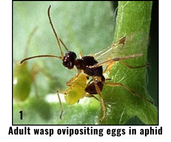
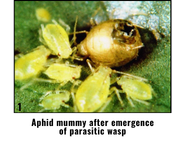
There are about 1000 species of Parasitic Wasps in the PNW. The adults lay their eggs on host insects such as aphids, caterpillars and whiteflies. Adult parasitic wasps are 1-2.4 cm with their larvae 1-2.6 cm. Their eggs can be various shapes and sizes.
2. Tachinid Flies
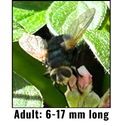
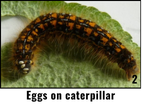
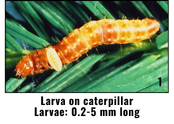
There are over 400 species of Tachinid Flies in the PNW. The adults usually lay their eggs on caterpillars as shown above. Adult tachinid flies also have the benefit of feeding on pollen and nectar which contributes to pollination as they move from flower to flower.
Predatory & Pollinating Insects
The following insects are common predators and pollinators in home gardens within the Pacific Northwest. While many people are concerned with the presence of these insects (yellow jackets and paper wasps), it is important to remember their important role and contribution to healthy ecosystems.
1. Yellow Jackets
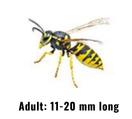
There are over 100 species of Yellow Jackets in the PNW. The adults feed on insects and other meat sources to regurgitate for larvae in their nests. Their bodies are elongated, smooth, black and yellow with a narrow waist and black antennae. The yellow jacket diet also includes fruit, flower nectar and tree sap, making them important pollinators as well as predators.
2. European Paper Wasp
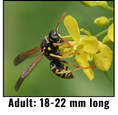
There is a single species of European Paper Wasp in the PNW. The adults feed on small, soft-bodied insects (many of them pests) to regurgitate for larvae in their nests. Their bodies are long and slender with legs that dangle as they fly. Paper wasps can be distinguished from yellow jackets by their black antennae with orange tips. Like yellow jackets, their diet also consists of pollen and nectar, making them important pollinators. They are non-aggressive, only eating critters they have killed themselves; they won’t come to your barbecue to scavenge, unlike yellow jackets.
How do I help the beneficial insects in my garden?
To learn more about supporting beneficial insects in your home garden, please visit our post here where we discuss this topic in more detail and provide access to the printable info sheet.
In short, to attract these insects to your garden, plant flowers! Adults of most of these insects need nectar and/or pollen to stay alive longer and lay more eggs. Tiny flowers for tiny mouth parts. Some other ways to support beneficial insects include:
- Providing small, shallow dishes of water.
- Minimizing cultivation by using no-till methods to avoid disturbing nests. Encourage tiny places for tiny critters.
- Providing layers of vegetation, including fallen leaves and dead branches, for nests, shelter, hunting.
- Avoiding poisons! This includes insecticides, miticides, fungicides, and herbicides. They kill indiscriminately which means the good bugs are harmed along with the bad.
Flowers that attract beneficial insects
- Yarrow
- Sweet Alyssum
- Dill
- Cilantro
- Calendula
- Candytuft
- Thymes
- Daisies
- Goldenrod
Resources
- Gilkeson, L.A. (2026). Beneficial Insect
- Photos by Elizabeth Cronin (cited in L. A. Gilkeson’s website under Beneficial Insects)
- Schulz, K. (2017). iNaturalist observation: inaturalist.org. Accessed May 18, 2026. Licensed under CC BY.
- Microscopia IWM. (2026). Metamorphosis and its types. Microscopia IWM.
- B.C. Ministry of Agriculture. (2016). Beneficial Insects, Predators, Parasitoids and Pollinators. Beneficial Insects
- Alexander, Yurika, (2012). https://www.bugguide.net/node/view/659366
Photo Credits
Numbered by resource. All other images by VIMGA members. Copyright 2026 Vancouver Island Master Gardeners Association.
Vancouver Island Master Gardeners
Vancouver Island Master Gardeners are local volunteers who educate the gardening public with current, science-based and environmentally responsible horticultural information. As a chapter of the Master Gardeners Association of BC (MGABC), our program and priorities shape healthy communities and a healthy planet.